


Page 375 - IJB-9-6
P. 375
International Journal of Bioprinting                                  Aflatoxin B1-induced cancer stem cells


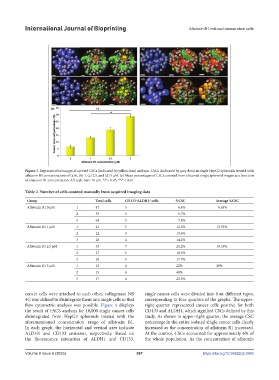
            Figure 3. Representative images of spotted CSCs (indicated by yellow dots) and non-CSCs (indicated by gray dots) in single HepG2 spheroids treated with
            aflatoxin B1 concentrations of (a) 0, (b) 1, (c) 2.5, and (d) 5 μM. (e) Mean percentages of CSCs counted from obtained single spheroid images as a function
            of aflatoxin B1 concentration. All scale bars: 10 μm. *P < 0.05, **P < 0.01.

            Table 2. Number of cells counted manually from acquired imaging data

             Group                        Total cells  CD133 ALDH1  cells   %CSC             Average %CSC
                                                                 +
                                                           +
             Aflatoxin B1 0 μM    1       47          3                      6.4%             6.63%
                                  2       53          3                      5.7%
                                  3       64          5                      7.8%
             Aflatoxin B1 1 μM    1       41          5                     12.2%            13.33%
                                  2       22          3                     13.6%
                                  3       28          4                     14.2%
             Aflatoxin B1 2.5 μM  1       33          7                     21.2%            19.19%
                                  2       27          5                     18.5%
                                  3       28          5                     17.9%
             Aflatoxin B1 5 μM    1       18          4                     22%              29%
                                  2       15          6                     40%
                                  3       17          4                     23.5%


            cancer cells were attached to each other, collagenase NB   single cancer cells were divided into four different types,
            4G was utilized to disintegrate them into single cells so that   corresponding to four quarters of the graphs. The upper-
            flow  cytometric  analysis  was  possible.  Figure  4  displays   right quarter represented cancer cells positive for both
            the result of FACS analysis for 10,000 single cancer cells   CD133 and ALDH1, which signified CSCs defined by this
            disintegrated from HepG2 spheroids treated with the   study. As shown in upper-right quarter, the average CSC
            aforementioned concentration range of aflatoxin B1.   percentage in the entire isolated single cancer cells clearly
            In each graph, the horizontal and vertical axes indicate   increased as the concentration of aflatoxin B1 increased.
            ALDH1  and  CD133  emission,  respectively.  Based  on   At the control, CSCs accounted for approximately 6% of
            the fluorescence intensities of ALDH1 and CD133,   the whole population. As the concentration of aflatoxin


            Volume 9 Issue 6 (2023)                        367                          https://doi.org/10.36922/ijb.0985

