


Page 376 - IJB-9-6
P. 376
International Journal of Bioprinting                                  Aflatoxin B1-induced cancer stem cells


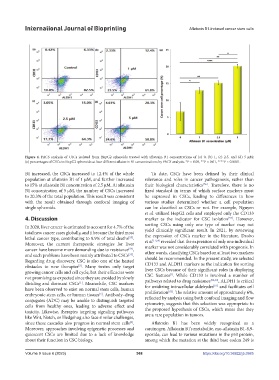
            Figure 4. FACS analysis of CSCs isolated from HepG2 spheroids treated with aflatoxin B1 concentrations of (a) 0, (b) 1, (c) 2.5, and (d) 5 μM;
            (e) percentages of CSCs in HepG2 spheroids at four different aflatoxin B1 concentrations by FACS analysis. *P < 0.05, **P < 0.01, ****P < 0.0001.

            B1 increased, the CSCs increased to 12.4% of the whole   To date, CSCs have been defined by their clinical
            population at aflatoxin B1 of 1 μM, and further increased   relevance and roles in cancer pathogenesis, rather than
                                                                                        [56]
            to 15% at aflatoxin B1 concentration of 2.5 μM. At aflatoxin   their biological characteristics . Therefore, there is no
            B1 concentration of 5 μM, the number of CSCs increased   fixed  standard  in terms  of which  surface  markers  must
            to 20.3% of the total population. This result was consistent   be  expressed  in CSCs,  leading  to  differences  in  how
            with the result obtained through confocal imaging of   various studies determined whether a cell population
            single spheroids.                                  can be classified as CSCs or not. For example, Nguyen
                                                               et al. utilized HepG2 cells and employed only the CD133
            4. Discussion                                      marker as the indicator for CSC isolation . However,
                                                                                                  [57]
                                                               sorting  CSCs  using  only  one  type  of  marker  may  not
            In 2020, liver cancer is estimated to account for 4.7% of the   yield  clinically  significant  result.  In  2021,  by  reviewing
            total new cancer cases globally, and it became the third most   the expression of CSCs marker in the literature, Dzobo
            lethal cancer type, contributing to 8.9% of total deaths .   et al. [1,58]  revealed that the expression of only one individual
                                                        [53]
            Moreover,  the current therapeutic  strategies  for  liver   marker was not considerably correlated with prognosis. In
            cancer have become more demanding due to resistance ,   other words, classifying CSCs based on at least two markers
                                                        [54]
            and such problems have been mainly attributed to CSCs .   should be recommended. In the present study, we selected
                                                        [55]
            Regarding drug discovery, CSC is also one of the heated   CD133 and ALDH1 markers as the indication for sorting
            obstacles to new therapies . Many toxins only target   liver CSCs because of their significant roles in displaying
                                  [3]
            growing cancer cells and cell cycle, but their efficacies were   CSC features . While CD133 is involved a number of
                                                                          [l]
            not promising as expected since they are avoided by slowly   pathways related to drug resistance [59,60] , ALDH1 is critical
            dividing and dormant CSCs . Meanwhile, CSC markers   for oxidizing intracellular aldehydes  and facilitates cell
                                   [1]
                                                                                            [61]
            have been observed to exist on normal stem cells, human   proliferation . The relative amount of approximately 6%,
                                                                         [62]
            embryonic stem cells, or human tissues . Antibody–drug   reflected by analysis using both confocal imaging and flow
                                           [5]
            conjugates (ADC) may be unable to distinguish targeted   cytometry, suggests that this selection was appropriate to
            cells from healthy ones, leading to adverse effect and   the proposed hypothesis of CSCs, which states that they
            toxicity. Likewise, therapies targeting signaling pathways   are a rare population in tumors.
            like Wnt, Notch, or Hedgehog also face similar challenges,
            since these cascades also progress in normal stem cells .   Aflatoxin B1 has been widely recognized as a
                                                        [2]
            Moreover, approaches involving epigenetic processes and   carcinogen. Aflatoxin B1’s metabolite, exo-aflatoxin B1-8,9-
            quiescent CSCs are limited due to a lack of knowledge   epoxide, can lead to various mutations in the p53 protein,
            about their function in CSC biology.               among which the mutation at the third base codon 249 is
            Volume 9 Issue 6 (2023)                        368                          https://doi.org/10.36922/ijb.0985

