


Page 39 - IJB-9-6
P. 39
International Journal of Bioprinting                                 Transdermal delivery of printed cisplatin


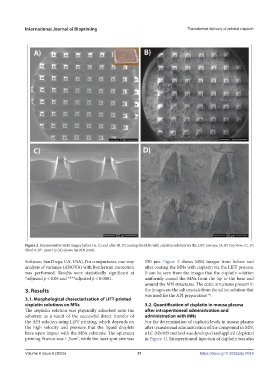
            Figure 2. Representative SEM images before (A, C) and after (B, D) coating the MNs with cisplatin solution via the LIFT process. (A, B) Top view; (C, D)
            tilted at 20°. Insert in (A) shows the MN patch.

            Software, San Diego, CA, USA). For comparisons, one-way   150 µm.  Figure 2 shows SEM images from before and
            analysis of variance (ANOVA) with Bonferroni correction   after coating the MNs with cisplatin via the LIFT process.
            was performed. Results were statistically significant at   It can be seen from the images that the cisplatin solution
            *adjusted p < 0.05 and ****adjusted p < 0.0001.    uniformly coated the MNs from the tip to the base and
                                                               around the MN structures. The cubic structures present in
            3. Results                                         the images are the salt crystals from the saline solution that
                                                               was used for the API preparation .
                                                                                         [36]
            3.1. Morphological characterization of LIFT-printed
            cisplatin solutions on MNs                         3.2. Quantification of cisplatin in mouse plasma
            The  cisplatin  solution  was  physically  adsorbed  onto  the   after intraperitoneal administration and
            substrate as a result of the successful direct transfer of   administration with MNs
            the API solution using LIFT printing, which depends on   For the determination of cisplatin levels in mouse plasma
            the high velocity and pressure that the liquid droplets   after transdermal administration of the compound in MN,
            have upon impact with the MNs substrate. The optimum   a LC-MS/MS method was developed and applied (depicted
            printing fluence was 1 J/cm , while the laser spot size was   in Figure 3). Intraperitoneal injection of cisplatin was also
                                  2

            Volume 9 Issue 6 (2023)                         31                        https://doi.org/10.36922/ijb.0048

