


Page 40 - IJB-9-6
P. 40
International Journal of Bioprinting                                 Transdermal delivery of printed cisplatin


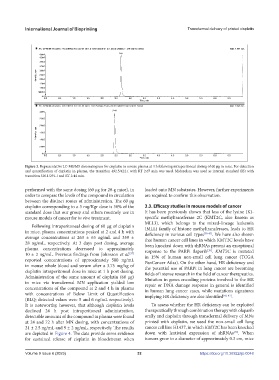
            Figure 3. Representative LC-MS/MS chromatogram for cisplatin in mouse plasma at 4 h following intraperitoneal dosing of 60 μg in mice. For detection
            and quantification of cisplatin in plasma, the transition 492.5/422.1 with RT 2.67 min was used. Midazolam was used as internal standard (IS) with
            transition 326.1/291.1 and RT 2.44 min.


            performed with the same dosing (60 μg for 20-g mice), in   loaded onto MN substrates. However, further experiments
            order to compare the levels of the compound in circulation   are required to confirm this observation.
            between the distinct routes of administration. The 60 μg
            cisplatin corresponding to a 3 mg/Kgr dose is 50% of the   3.3. Efficacy studies in mouse models of cancer
            standard dose that our group and others routinely use in   It has been previously shown that loss of the lysine (K)‐
            mouse models of cancer for in vivo treatment.      specific methyltransferase 2C (KMT2C, also known as
                                                               MLL3), which belongs to the mixed‐lineage leukemia
               Following intraperitoneal dosing of 60 μg of cisplatin   (MLL) family of histone methyltransferases, leads to HR
            in mice, plasma concentrations peaked at 2 and 4 h with   deficiency in various cell types [38-40] . We have also shown
            average concentrations at 263 ± 63 ng/mL and 359 ±   that human cancer cell lines in which KMT2C levels have
            28 ng/mL, respectively. At 3 days post dosing, average   been knocked down with shRNAs present an exceptional
            plasma concentrations decreased to approximately   response to the PARPi ilaparib .  KMT2C is mutated
                                                                                         [38]
            10 ± 2 ng/mL. Previous findings from Johnsson et al.    in 15% of human non-small cell lung cancer (TCGA
                                                        [37]
            reported concentrations of approximately 500 ng/mL   PanCancer Atlas). On the other hand, HR deficiency and
            in mouse whole blood and serum after a 3.75 mg/kg of   the potential use of PARPi in lung cancer are becoming
            cisplatin intraperitoneal dose in mice at 1 h post dosing.   fields of intense research in the field of cancer therapeutics.
            Administration of the same amount of cisplatin (60 μg)   Mutation in genes encoding proteins involved in the HR
            in mice via transdermal MN application yielded low   repair or DNA damage response in general is identified
            concentrations of the compound at 2 and 4 h in plasma   in  human  lung  cancer  cases,  while  mutations  signatures
            with concentrations of Below Limit of Quantification   implying HR deficiency are also identified [41-43] .
            (BLQ; detected values were 5 and 6 ng/mL respectively).
            It is noteworthy, however, that although cisplatin levels   To assess whether the HR deficiency can be exploited
            declined 24 h post intraperitoneal administration,   therapeutically through combination therapy with olaparib
            detectable amounts of the compound in plasma were found   orally and cisplatin through transdermal delivery of MNs
            at 24 and 72 h after MN dosing, with concentrations of   printed with cisplatin, we used the non-small cell lung
            21 ± 2.5 ng/mL and 9 ± 2 ng/mL, respectively. The results   cancer cell line H1437, in which KMT2C has been knocked
                                                                                                     [38]
            are depicted in Figure 4. The data provide some evidence   down with lentiviral expression of shRNAs . When
            for sustained release of cisplatin  in bloodstream when   tumors grew to a diameter of approximately 0.3 cm, mice

            Volume 9 Issue 6 (2023)                         32                        https://doi.org/10.36922/ijb.0048

