


Page 41 - IJB-9-6
P. 41
International Journal of Bioprinting                                 Transdermal delivery of printed cisplatin


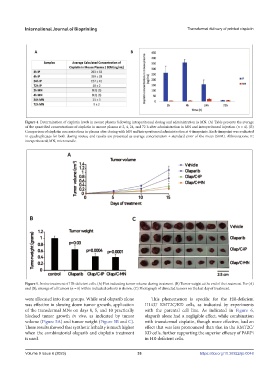
            Figure 4. Determination of cisplatin levels in mouse plasma following intraperitoneal dosing and administration in MN. (A) Table presents the average
            of the quantified concentrations of cisplatin in mouse plasma at 2, 4, 24, and 72 h after administration in MN and intraperitoneal injection (n = 4). (B)
            Comparison of cisplatin concentrations in plasma after dosing with MN and intraperitoneal administration at 4 timepoints. Each timepoint was evaluated
            in quadruplicates for both dosing routes, and results are presented as average concentration ± standard error of the mean (SEM). Abbreviations: IP,
            intraperitoneal; MN, microneedle.


            Figure 5. In vivo treatment of HR-deficient cells. (A) Plot indicating tumor volume during treatment. (B) Tumor weight at the end of the treatment. For (A)
            and (B), average of all tumors (n = 8) within indicated cohorts is shown. (C) Photograph of dissected tumors on the last day of treatment.

            were allocated into four groups. While oral olaparib alone   This phenomenon is specific for the HR-deficient
            was effective in slowing down tumor growth, application   H1437 KMT2C/KD cells, as indicated by experiments
            of the transdermal MNs on days 0, 5, and 10 practically   with the parental cell line. As indicated in  Figure 6,
            blocked tumor growth  in vivo, as indicated by tumor   olaparib alone had a negligible effect, while combination
            volume (Figure 5A) and tumor weight (Figure 5B and C).    with transdermal cisplatin, though more effective, had an
            These results showed that synthetic lethality is much higher   effect that was less pronounced than that in the KMT2C/
            when the combinatorial olaparib and cisplatin treatment   KD cells, further supporting the superior efficacy of PARPi
            is used.                                           in HR-deficient cells.


            Volume 9 Issue 6 (2023)                         33                        https://doi.org/10.36922/ijb.0048

