


Page 423 - IJB-9-6
P. 423
International Journal of Bioprinting                                Versatile pomelo peel-inspired structures


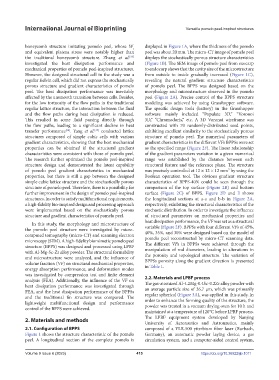
            honeycomb structure imitating pomelo peel, whose  W   s  displayed in Figure 1A, where the thickness of the pomelo
            and equivalent plateau stress were notably higher than   peel was about 20 mm. The micro-CT image of pomelo peel
            the traditional honeycomb structure. Zhang  et  al.     displays the stochastically porous structure characteristics
                                                        [33]
            investigated the heat dissipation performance and   (Figure 1B). The SEM image of pomelo peel from exocarp
            mechanical properties of pomelo peel-inspired structures.   to endocarp shows that the cavity size of the microstructure
            However, the designed structural cell in the study was a   from outside to inside gradually increased (Figure 1C),
            regular Kelvin cell, which did not express the stochastically   revealing the natural gradient structure characteristics
            porous structure and gradient characteristics of pomelo   of pomelo peel. The BPPS was designed based on the
            peel. The heat dissipation performance was inevitably   morphology and microstructure observed in the pomelo
            affected by the unsmooth transition between cells. Besides,   peel (Figure  2A).  Precise  control  of the  BPPS  structure
            for the low tortuosity of the flow paths in the traditional   modeling was achieved by using Grasshopper software.
            regular lattice structure, the interaction between the fluid   The specific design tools (battery) in the Grasshopper
            and the flow paths during heat dissipation is reduced.   software mainly included “Populate 3D,” “Voronoi
            This  resulted  in  some  fluid  passing  directly  through   3D,” “Chromodoris,” etc. A 3D Voronoi wireframe was
            the  flow  paths,  leading  to  a  significant  decline  in  heat   constructed with 70 randomly-distributed seed points,
            transfer performance . Yang  et al.  conducted lattice   exhibiting excellent similarity to the stochastically porous
                             [34]
                                         [35]
            structures composed of simple cubic cells with various   structure of pomelo peel. The numerical parameters of
            gradient characteristics, showing that the best mechanical   gradient characteristics in the different VFs BPPSs were set
            properties can be obtained if the structural gradient   as the specified range (Figure 2F). The linear relationship
            characteristics were consistent with those of pomelo peel.   of the gradient parameters variation in a given numerical
            The research further optimized the pomelo peel-inspired   range  was  established  by  the  distance  between  each
            structure design and demonstrated the latent capability   structural feature and the reference plane. The structure
            of pomelo peel gradient characteristics in mechanical   was precisely controlled at 12 × 12 × 12 mm³ by using the
            properties, but there is still a gap between the designed   Boolean operation tool. The obvious gradient structure
            simple cubic lattice structure and the stochastically porous   characteristics of BPPS-40% could be seen through the
            structure of pomelo peel. Therefore, there is a possibility for   comparison of  the  top  surface  (Figure  2B)  and bottom
            further improvement in the design of pomelo peel-inspired   surface (Figure 2C) of BPPS.  Figure 2D and  E shows
            structures. In order to satisfy multifunctional requirements,   the longitudinal sections at a-a and b-b in  Figure 2A,
            a high-fidelity bio-inspired design and processing approach   respectively, exhibiting the structural characteristics of the
            were implemented based on the stochastically porous   stochastic distribution. In order to investigate the influence
            structure and gradient characteristics of pomelo peel.  of structural parameters on mechanical properties and

               In this study, the morphology and microstructure of   heat dissipation performance, the VF was set as a structural
            the pomelo peel structure were investigated by micro-  variable (Figure 2F). BPPSs with four different VFs of 45%,
            computed tomography (micro-CT) and scanning electron   40%, 35%, and 30% were designed based on the model of
            microscopy (SEM). A high-fidelity biomimetic pomelo peel   pomelo peel reconstructed by micro-CT scanning data.
            structure (BPPS) was designed and processed using LPBF   The different  VFs in BPPSs were achieved through the
            with Al-Mg-Sc-Zr alloy powder. The structural formability   manipulation  of  rod  diameters,  leading  to  alterations  in
            and microstructure were  analyzed, and the influence  of   the porosity and topological structure. The variation of
            volume fraction (VF) on structural mechanical properties,   BPPSs porosity along the gradient direction is presented
            energy absorption performance, and deformation modes   in Table 1.
            was investigated by compression test and finite element
            analysis (FEA). Additionally, the influence of the VF on   2.2. Materials and LPBF process
            heat dissipation performance was investigated through   The gas-atomized Al-4.2Mg-0.4Sc-0.2Zr alloy powder with
            FEA, and the heat dissipation performance of the BPPSs   an average particle size of 26.7 μm, which was primarily
            and the traditional fin structure was compared. The   regular spherical (Figure 3A), was applied in this study. In
            lightweight multifunctional design and performance   order to enhance the forming quality of the structure, the
            control of the BPPS were achieved.                 powder was treated in a vacuum drying oven for 10 h and
                                                               maintained at a temperature of 120°C before LPBF process.
            2. Materials and methods                           The LPBF equipment system developed by Nanjing
                                                               University of Aeronautics and Astronautics, mainly
            2.1. Configuration of BPPS                         composed of a YLR-500 ytterbium fiber laser (Burbach,
            Figure 1 shows the structure characteristic of the pomelo   Germany), an automatic powder laying device, a gas
            peel. A longitudinal section of the complete pomelo is   circulation system, and a computer-aided control system,

            Volume 9 Issue 6 (2023)                        415                         https://doi.org/10.36922/ijb.1011

