


Page 488 - IJB-9-6
P. 488
International Journal of Bioprinting                              Bioprinting cell-laden protein-based hydrogel


            specific tissue (cartilage or bone), and different signaling   of encapsulated cells into a desired structure. Although
            pathways which occur within the cells (autocrine,   many PBHs, such as collagen and fibrin, exhibit the above-
            intracrine, endocrine, paracrine, and juxtacrine signaling)   mentioned qualities, they cannot be readily tailored, and
            or those received from other cells. In the fields of cartilage   there are several challenges in their printing [163] . Bioprinting
            and bone TE, several research projects have been conducted   strategies and bioink properties are directly influenced by
            so far to assess the impacts of mentioned environmental   chemical, physical, and biological characteristics; in this
            cues on the cellular features and tissue development ability   regard, Figure 4 presents key considerations required for
            of the PBHs. The original experiments mentioned above,   bioprinting cell-laden PBHs.
            alongside the achieved outcomes, will hopefully provide a
            comprehensive roadmap to move these fields forward.  4.1. Mechano-rheological considerations
                                                               To be an optimal bioink for various bioprinting modalities,
            4. Process compatibility considerations of         a material must possess several essential characteristics; for
            PBHs                                               instance, a major factor affecting biomaterial printability
                                                               is its mechanical properties. In multiple  cases, scholars
            Bioprinting requires the proper design of a bioink to   perform long-term incubation of cell-laden constructs for
            support tissue growth, cellular viability, and printability [160] ,   tissue development, and an integral part of this procedure
            and an efficient transfer of nutrients and oxygen within the   is  guaranteeing  structural  integrity. Notably,  a printed
            bioink must be ensured by the PBH’s structure [161] .  construct should provide oxygen and nutrient transport
                                                               into the cells, a critical subject to consider when designing
               Biocompatibility  and  mechano-rheological  features        [164]
            are primarily responsible for bioink printability.   its architecture  .
            Biocompatibility is essential in developing bioinks to   Inkjet and extrusion-based bioprinting techniques are
            prevent  adverse  effects  on the  viability, proliferation,   based on viscoelasticity and rheological characterization.
            or differentiation of cells encapsulated within [162] .   PBHs and the amino acid sequences of fibrous proteins,
            Moreover, a bioink with appropriate mechano-rheological   including collagen, elastin, silk fibroin, keratin, resilin,
            characteristics can be extruded easily, maintain its shape   and fibrin, play both mechanical and architectural roles
            after printing, and support the deposition and organization   in nature, which make them attractive choices for these

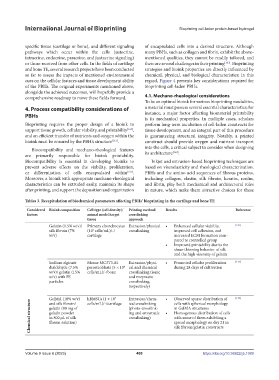
            Tables 3. Recapitulation of biochemical parameters affecting PBHs’ bioprinting in the cartilage and bone TE
             Considered  Bioink composition  Cell type (cell density)/  Printing method/  Results    Reference
             factors                  animal model/target   crosslinking
                                      tissue            approach
                      Gelatin (1.5% w/v)/  Primary chondrocytes   Extrusion/physical  •   Enhanced cellular viability,   [136]
                      silk fibroin (7%   (10  cells/mL)/-/  crosslinking   improved cell adhesion, and
                                         6
                      w/v)            cartilage                            increased ECM formation com-
                                                                           pared to controlled group
                                                                        •   Improved printability due to the
                                                                           shear-thinning behavior of silk
                                                                           and the high viscosity of gelatin
                      Sodium alginate   Mouse MC3T3-E1   Extrusion/physi-  •   Promoted cellular proliferation   [137]
                      dialdehyde (7.5%   preosteoblasts (5 × 10   cal and chemical   during 28 days of cultivation
                                                      6
                      w/v)/ gelatin (15%   cells/mL)/-/bone  crosslinking (ionic
                      w/v) with FS                      and enzymatic
                      particles                         crosslinking,
                                                        respectively)


                      GelMA (10% w/v)   hBMSCs (1 × 10    Extrusion/chem-  •   Observed sparse distribution of   [138]
                                                  7
              Chemical structure  gelatin (80 mg of     (photo-crosslink-  •   in GelMA structures
                                                                           cells with spherical morphology
                                                        ical crosslinking
                                      cells/mL)/-/cartilage
                      and silk fibroin/
                      gelatin powder
                                                        ing and enzymatic
                                                                           Homogenous distribution of cells
                                                                           with some of them exhibiting a
                                                        crosslinking)
                      in 800 µL of silk
                                                                           spread morphology on day 21 in
                      fibroin solution)
                                                                           silk fibroin/gelatin constructs
            Volume 9 Issue 6 (2023)                        480                          https://doi.org/10.36922/ijb.1089

