


Page 490 - IJB-9-6
P. 490
International Journal of Bioprinting                              Bioprinting cell-laden protein-based hydrogel


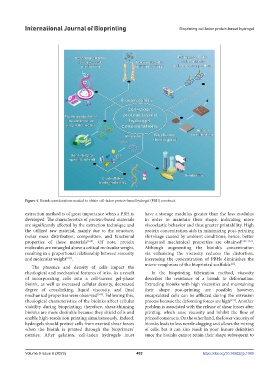
            Figure 4. Bioink considerations needed to obtain cell-laden protein-based hydrogel (PBH) construct.

            extraction method is of great importance when a PBH is   have a storage modulus greater than the loss modulus
            developed. The characteristics of protein-based materials   in order to maintain their shape, indicating more
            are significantly affected by the extraction technique and   viscoelastic behavior and thus greater printability. High
            the utilized raw material, mainly due to the structure,   protein concentration aids in minimizing post-printing
            molar mass distribution, composition, and functional   shrinkage caused by ambient conditions; hence, better
            properties of these materials [168] . Of note, protein   integrated mechanical properties are obtained [169-172] .
            molecules are entangled above a critical molecular weight,   Although augmenting the bioink’s concentration
            resulting in a proportional relationship between viscosity   via enhancing the viscosity reduces the distortion,
            and molecular weight [168] .                       increasing the concentration of PBHs diminishes the
               The presence and density of cells impact the    micro-roughness of the bioprinted scaffolds [25] .
            rheological and mechanical features of inks. As a result   In the bioprinting fabrication method, viscosity
            of incorporating cells into a cell-barren gel-phase   describes the resistance of a bioink to deformation.
            bioink, as well as increased cellular density, decreased   Extruding bioinks with high viscosities and maintaining
            degree of crosslinking, liquid viscosity, and final   their shape post-printing are possible; however,
            mechanical properties were observed [169] . Following this,   encapsulated  cells  can  be  afflicted  during  the  extrusion
            rheological characteristics of the bioinks affect cellular   process because the deforming forces are high [173] . Another
            viability during bioprinting; therefore, shear-thinning   problem is associated with the release of shear forces after
            bioinks are more desirable because they shield cells and   printing, which raise viscosity and inhibit the flow of
            enable high-resolution printing simultaneously. Indeed,   printed constructs. On the other hand, the lower viscosity of
            hydrogels should protect cells from exerted shear forces   bioinks leads to less nozzle clogging and allows the mixing
            when the bioink is printed through the bioprinters’   of cells, but it can also result in poor feature definition
            nozzles.  After  gelation,  cell-laden  hydrogels  must   since the bioinks cannot retain their shape subsequent to


            Volume 9 Issue 6 (2023)                        482                          https://doi.org/10.36922/ijb.1089

