


Page 89 - IJB-9-6
P. 89
International Journal of Bioprinting                                     Review of 3D bioprinted organoids


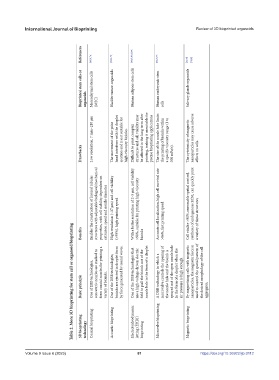
                                    References  [49,50,74]  [51,61,75]  [49,60,61,63,64]  [61,76,77]  [52,78]  [79,80]


                                    Bioprinted stem cells or   organoids  Mesenchymal stem cells   (MSC)  Bladder tumor organoids  Human adipose stem cells  Human embryonic stem   cells  Salivary glands organoids


                                        Low resolution, 7 mm–210 µm  The movement of the print  head interferes with the droplet  ejection and is not suitable for   high-viscosity bioinks.  Difficult to print complex  structures and cell viability may  be affected in the long term after  printing, making it unsuitable for  precise bioprinting applications  The size of the nozzle hole limits  the printing of bioinks within  a specific viscosity range (1 to   The cytotoxici


                                    Drawbacks                              200 mPa/s).  effects on cells.


                                        Enables the construction of layered tubular  structures with adjustable biological/mechanical  properties, with cell viability dependent on  extrusion speed and nozzle diameter High resolution (~37 µm) and cell viability  (>90%), high printing speed  With a better resolution of 2–5 µm, cell viability  >90%, suitable for printing high-viscosity   Accurate cell localization, high cell survival rate   Cell vitality >90%, reasonable spa


                                Table 2. More 3D bioprinting for stem cell or organoid bioprinting
                                    Benefits                  bioinks  >86%, fast printing speed


                                    Basic principle  One of EBB technologies,  concentric nozzles are stacked to  form coaxial nozzles for printing a   variety of bioinks.  One of the DBB technologies,  bioinks are ejected in droplet form  by force generated by sound waves.  One of the DBB technologies that  use a high-voltage-driven electric  field to pull the bioink out of the  nozzle hole in the form of a droplet  A DBB technology in which a  microvalve controls the op


                                    3D bioprinting   technology  Coaxial bioprinting  Acoustic bioprinting  Electrohydrodynamic   jetting (EHDJ)   bioprinting  Microvalve bioprinting  Magnetic bioprinting


            Volume 9 Issue 6 (2023)                         81                         https://doi.org/10.36922/ijb.0112

