


Page 93 - IJB-9-6
P. 93
International Journal of Bioprinting                                     Review of 3D bioprinted organoids


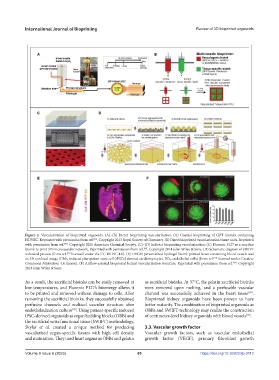
            Figure 4. Vascularization of bioprinted organoids. (A)–(B) Direct bioprinting vascularization: (A) Coaxial bioprinting of GPT bioinks containing
            HUVEC. Reprinted with permission from ref. . Copyright 2013 Royal Society of Chemistry. (B) Direct bioprinted vascularization tissue units. Reprinted
                                         [86]
            with permission from ref. . Copyright 2021 American Chemical Society. (C)–(D) Indirect bioprinting vascularization: (C) Pluronic F127 as a sacrifice
                            [87]
            bioink to print 3D microvascular network. Reprinted with permission from ref. . Copyright 2014 John Wiley & Sons. (D) Schematic diagram of SWIFT
                                                              [88]
            technical process (from ref.  licensed under the CC BY-NC 4.0). (E) DECM personalized hydrogel bioink-printed heart containing blood vessels and
                             [89]
            its 3D confocal image (CMs, induced pluripotent stem cell (iPSCs) derived cardiomyocytes, ECs, endothelial cells) (from ref.  licensed under Creative
                                                                                            [93]
            Commons Attribution 4.0 license). (F) Airflow-assisted bioprinted helical vascularization structure. Reprinted with permission from ref. . Copyright
                                                                                                    [94]
            2018 John Wiley & Sons.
            As a result, the sacrificial bioinks can be easily removed at   as sacrificial bioinks. At 37°C, the gelatin sacrificial bioinks
            low temperatures, and Pluronic F127’s bioenergy allows it   were removed upon melting, and a perfusable vascular
            to be printed and removed without damage to cells. After   channel was successfully achieved in the heart tissue .
                                                                                                           [89]
            removing the sacrificial bioinks, they successfully obtained   Bioprinted kidney organoids have been proven to have
            perfusive channels and realized vascular structure after   better maturity. The combination of bioprinted organoids as
                                [88]
            endothelialization culture . Using patient-specific induced   OBBs and SWIFT technology may realize the construction
            iPSC-derived organoids as organ building blocks (OBB) and   of centimeter-level kidney organoids with blood vessels .
                                                                                                          [90]
            the sacrificial write functional tissue (SWIFT) methodology,
            Skylar  et  al. created a unique method for producing   3.3. Vascular growth factor
            vascularized organ-specific tissues with high cell density   Vascular  growth  factors, such as  vascular endothelial
            and maturation. They used heart organs as OBBs and gelatin   growth factor (VEGF), primary fibroblast growth


            Volume 9 Issue 6 (2023)                         85                         https://doi.org/10.36922/ijb.0112

