


Page 86 - IJB-9-6
P. 86
International Journal of Bioprinting                                     Review of 3D bioprinted organoids


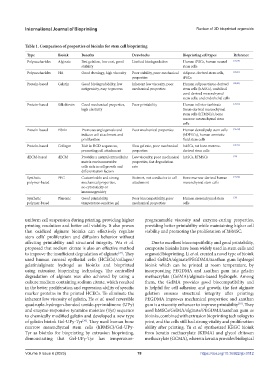
            Table 1. Comparison of properties of bioinks for stem cell bioprinting
             Type         Bioink    Benefits             Drawbacks             Bioprinting cell types  Reference
             Polysaccharides  Alginate  Fast gelation, low cost, good   Limited biodegradation  Human iPSCs, human neural   [18,19]
                                    stability                                  stem cells
             Polysaccharides  HA    Good rheology, high viscosity  Poor stability, poor mechanical  Adipose-derived stem cells,   [20,21]
                                                         properties            iPSCs
             Protein-based  Gelatin  Good biodegradability, low   Inherent low viscosity, poor   Human adipose tissue-derived   [22,23]
                                    antigenicity, easy to process  mechanical properties  stem cells (hASCs), umbilical
                                                                               cord-derived mesenchymal
                                                                               stem cells, and endothelial cells
             Protein-based  Silk fibroin  Good mechanical properties,   Poor printability  Human inferior turbinate   [24,25]
                                    high elasticity                            tissue-derived mesenchymal
                                                                               stem cells (hTMSCs), bone
                                                                               marrow mesenchymal stem
                                                                               cells
             Protein-based  Fibrin  Promotes angiogenesis and   Poor mechanical properties  Human dental pulp stem cells   [26-28]
                                    induces cell attachment and                (hDPSCs), human amniotic
                                    proliferation                              fluid stem cells
             Protein-based  Collagen  Rich in RGD sequences,   Slow gel rate, poor mechanical   hASCs, rat bone marrow-  [29-31]
                                    promoting cell attachment  properties      derived stem cells
             dECM-based   dECM      Provides a natural extracellular  Low viscosity, poor mechanical  hASCs, hTMSCs  [32]
                                    matrix environment for   properties, fast degradation
                                    cells rich in cell growth and   rate
                                    differentiation factors
             Synthetic    PEG       Customizable and strong   Bioinert, not conducive to cell   Bone marrow-derived human   [33,34]
             polymer-based          mechanical properties,   attachment        mesenchymal stem cells
                                    no cytotoxicity or
                                    immunogenicity
             Synthetic    Pluronic  Good printability,   Poor biocompatibility, poor  Human mesenchymal stem   [35]
             polymer-based          temperature-sensitive gel  mechanical properties  cells


            uniform cell suspension during printing, providing higher   programmable  viscosity and enzyme-curing  properties,
            printing resolution and better cell viability. It also proves   providing better printability while maintaining higher cell
            that  oxidized alginate  bioinks  can effectively regulate   viability and promoting the proliferation of hBMSC.
            stem cells’ proliferation and diffusion behavior without
            affecting printability and structural integrity. Wu  et  al.   Due to excellent biocompatibility and good printability,
            proposed that sodium citrate is also an effective method   composite bioinks have been widely used in stem cells and
            to improve the insufficient degradation of alginate . They   organoid bioprinting. Li et al. created a novel type of bioink
                                                   [37]
            used human corneal epithelial cells (HCECs)/collagen/  called GelMA/alginate/PEGDMA/xanthan gum hydrogel
            gelatin/alginate hydrogel as bioinks and bioprinted   bioink which can be printed at room temperature, by
            using extrusion bioprinting technology. The controlled   incorporating PEGDMA and xanthan gum into gelatin
            degradation of alginate was also achieved by using a   methacrylate (GelMA)/alginate-based hydrogels. Among
            culture medium containing sodium citrate, which resulted   them,  the  GelMA  provides good biocompatibility and
            in the better proliferation and expression ability of specific   is helpful for cell adhesion and growth; the fast alginate
            marker proteins in the printed HCECs. To eliminate the   gelation ensures structural integrity after printing;
            inherent low viscosity of gelatin, He et al. used reversible   PEGDMA improves mechanical properties; and xanthan
            quadruple-hydrogen-bonded ureido-pyrimidinone (UPy)   gum is a viscosity enhancer to improve printability . They
                                                                                                       [39]
            and enzyme-responsive tyramine moieties (Tyr) sequence   used hMSCs/GelMA/alginate/PEGDMA/xanthan gum as
            to chemically modified gelatin and developed a new type   bioinks, combined with extrusion bioprinting technology to
            of gelatin bioink Gel-UPy-Tyr . They used human bone   print, and the cells still had strong vitality and proliferation
                                    [38]
            marrow mesenchymal stem cells (hBMSC)/Gel-UPy-     ability after printing. Yu et al. synthesized KEGC bioink
            Tyr as bioinks for bioprinting by extrusion bioprinting,   from keratin methacrylate (KEMA) and glycol chitosan
            demonstrating that Gel-UPy-Tyr has temperature-    methacrylate (GCMA), wherein keratin provides biological


            Volume 9 Issue 6 (2023)                         78                         https://doi.org/10.36922/ijb.0112

