


Page 85 - IJB-9-6
P. 85
International Journal of Bioprinting                                     Review of 3D bioprinted organoids


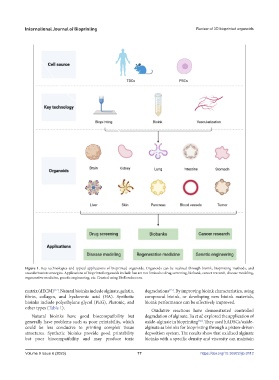
            Figure 1. Key technologies and typical applications of bioprinted organoids. Organoids can be realized through bioink, bioprinting methods, and
            vascularization strategies. Applications of bioprinted organoids include but are not limited to drug screening, biobank, cancer research, disease modeling,
            regenerative medicine, genetic engineering, etc. Created using BioRender.com.

                                                                         [15]
                        [17]
            matrix (dECM) . Natural bioinks include alginate, gelatin,   degradations . By improving bioink characteristics, using
            fibrin,  collagen, and  hyaluronic  acid  (HA).  Synthetic   compound bioink, or developing new bioink materials,
            bioinks include polyethylene glycol (PEG), Pluronic, and   bioink performance can be effectively improved.
            other types (Table 1).                                Oxidative reactions have demonstrated controlled
               Natural bioinks have good biocompatibility but   degradation of alginate. Jia et al. explored the application of
            generally have problems such as poor printability, which   oxide-alginate in bioprinting . They used hADSCs/oxide-
                                                                                      [36]
            could be less conducive to printing complex tissue   alginate as bioinks for bioprinting through a piston-driven
            structures. Synthetic bioinks provide good printability   deposition system. The results show that oxidized alginate
            but  poor  biocompatibility  and may  produce  toxic   bioinks with a specific density and viscosity can maintain


            Volume 9 Issue 6 (2023)                         77                         https://doi.org/10.36922/ijb.0112

