


Page 124 - IJOCTA-15-1
P. 124
D. Kasinathan et.al. / IJOCTA, Vol.15, No.1, pp.103-122 (2025)
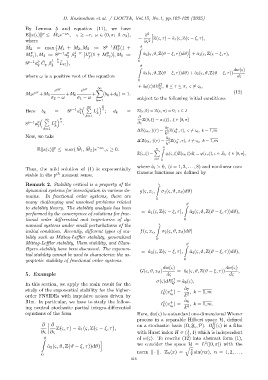
By Lemma 5 and equation (11), we have
˜
p
E∥x(ς)∥ ≤ M 2 e −ως , ς ≥ −r, ω ∈ (0, σ 1 Λ σ 2 ), ∂ 2 h
= Z(ς, τ) − ˆa 1 (ς, Z(ς − ξ, τ),
where ∂ς 2
˜
M g (1 +
M 2 = max M 1 + M 2 , M 3 := 8 p−1 ¯ p Z ϑ
i
p p−1 p 1−p p p ˆ a 2 (ς, ϑ, Z(ϑ − ξ, τ))dϑ) + ˆa 3 (ς, Z(ς − ξ, τ),
2 2 f
M σ 1 ), M 4 := 8 a β [L (1 + M σ 2 )], M 5 :=
p
a C p β
L G ,
8 p−1 p ˜ 1− 2 ¯ 0
2 2 ϑ
Z
dw(ς)
ˆ a 4 (ς, ϑ, Z(ϑ − ξ, τ))dϑ) + ˆa 5 (ς, ϑ, Z(ϑ − ξ, τ))
where ω is a positive root of the equation dς
0
H
+ ˆa 6 (ς)dB , 0 ≤ τ ≤ π, ς ̸= ς k ,
Q
∞
e ωr e ωr X
ωr (12)
M 3 e +M 5 +M 6 + (b k +d k ) = 1.
σ 2 − ω σ 1 − ω subject to the following initial conditions
k=1
∞ p
p−1 p P 1 q
Here = 8 a L ; = Z(ς, 0) = Z(ς, π) = 0; ς ∈ J
b k
1 k d k
k=1 ∂
∞ p Z(0, ξ) = x 1 (ξ), ξ ∈ [0, π]
p−1 p P 2 q ∂ς
8 a L .
2 k
k=1 ˆ a 7 +
∆Z(ς k , ·)(τ) = Z(ς , τ), ς ̸= ς k , k = 1, m
k 2 k
Now, we take
−
′
∆ Z(ς k , ·)(τ) = ˆ a 8 Z(ς , τ), t ̸= ς k , k = 1, m
k 4 k
p
˜
˜
E∥x(ς)∥ ≤ max{M 1 , M 2 }e −ως , ς ≥ 0. X π
n Z
Z(ς, ξ) − q i (ς, ξ)Z(ς i , ξ)dξ = φ(ς, ξ), ς ∈ J 0 , ξ ∈ [0, π],
i=1
0
where ˆa i > 0, (i = 1, 2, . . . , 8) and nonlinear con-
Thus, the mild solution of (1) is exponentially
stable in the p th moment sense. tinuous functions are defined by
Remark 2. Stability critical is a property of the Z ς
dynamical systems for investigation in various do- g(ς, x ς , σ 1 (ς, ϑ, x ϑ )dϑ)
mains. In fractional order systems, there are
0
many challenging and unsolved problems related
ϑ
to stability theory. The stability analysis has been Z
performed by the convergence of solutions for frac- = ˆa 1 (ς, Z(ς − ξ, τ), ˆ a 2 (ς, ϑ, Z(ϑ − ξ, τ))dϑ),
tional order differential and trajectories of dy- 0
namical systems under small perturbations of the Z ς
initial condition. Recently, different types of sta- f(ς, x ς , σ 2 (ς, ϑ, x ϑ )dϑ)
bility such as Mittag-Leffler stability, generalized
0
Mittag-Leffler stability, Ulam stability, and Ulam- ϑ
Z
Hyers stability have been discussed. The exponen-
= ˆa 3 (ς, Z(ς − ξ, τ), ˆ a 4 (ς, ϑ, Z(ϑ − ξ, τ))dϑ),
tial stability cannot be used to characterize the as-
ymptotic stability of fractional order systems. 0
dw(ς) dw(ς)
G(ς, ϑ, x ϑ ) = ˆa 5 (ς, ϑ, Z(ϑ − ξ, τ)) ,
5. Example dς dς
σ(ς)dB H = ˆa 6 (ς),
In this section, we apply the main result for the Q
study of the exponential stability for the higher- I (x ) = ˆ a 7 , k = 1, m
1
+
order FNSIDEs with impulsive noises driven by k ς k k 2
fBm. In particular, we have to study the follow- 2 + ˆ a 8
I (x ) = , k = 1, m.
k
ing neutral stochastic partial integro-differential ς k k 4
equations of the form Here, dw(ς) is a standard one-dimensional Wiener
process in a separable Hilbert space H, defined
∂ h ∂ on a stochastic basis (Ω, F ς , P). B (ς) is a fBm
H
Z(ς, τ) − ˆa 1 (ς, Z(ς − ξ, τ), Q
1
∂ς ∂ς with Hurst index H ∈ ( , 1) which is independent
2
ϑ of w(ς). To rewrite (12) into abstract form (1),
Z
i 2
we consider the space H = L ([0, π]) with the
ˆ a 2 (ς, ϑ, Z(ϑ − ξ, τ))dϑ) q
norm ∥ · ∥. Z n (x) = 2 sin(nx), n = 1, 2, . . . ,
0 π
118

