


Page 139 - IJOCTA-15-1
P. 139
Duality for robust multi-dimensional vector variational control problem under invexity
¯
¯
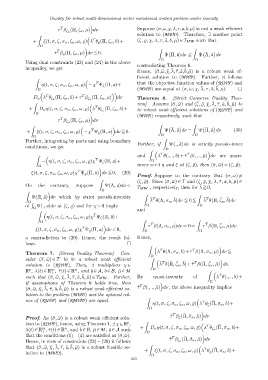
T Suppose (¯σ, ¯ω, ¯χ,λ,¯τ,¯ a,b, ¯µ) is not a weak efficient
τ β ζ κ (Π, ζ κ , µ) dν
solution to (MWD). Therefore, ∃ another point
Z
T
+ ξ(t, σ, ζ, σ κ , ζ κ , ω, ϱ) λ θ ϱ (Π, ζ κ , b)+ (ζ, ϱ, χ, λ, τ, ¯ a, b, µ)∈T MW such that
Ω
Z Z
T
τ β ϱ (Π, ζ κ , µ) dν ≦0. ¯
Ψ(Π, ¯ a)dν ≧ Ψ Λ, ¯ a dν
Ω Ω
Using dual constraints (23) and (24) in the above
contradicting Theorem 6.
inequality, we get
¯
¯
Hence, (¯σ, ¯ω, ¯χ,λ,¯τ,¯ a,b, ¯µ) is a robust weak ef-
ficient solution to (MWD). Further, it follows
Z
T
η(t, σ, ζ, σ κ , ζ κ , ω, ϱ) −χ Ψ ζ (Π, ¯ a)+ that the objective function values of (RUVP) and
¯
¯
Ω (MWD) are equal at (¯σ, ¯ω, ¯χ, λ, ¯τ, ¯ a, b, ¯µ). □
T T
D κ λ θ ζ κ (Π, ζ κ , b)+τ β ζ κ (Π, ζ κ , µ) dν Theorem 8. [Strict Converse Duality Theo-
rem] Assume (¯σ, ¯ω) and (ζ, ¯ϱ, ¯χ, λ, ¯τ, ¯ a, b, ¯µ) to
Z ¯ ¯ ¯
T
+ D κ η(t, σ, ζ, σ κ , ζ κ , ω, ϱ) λ θ ζ κ (Π, ζ κ , b)+ be robust weak efficient solutions of (RUVP) and
Ω
(MWD) respectively, such that
T
τ β ζ κ (Π, ζ κ , µ) dν
Z Z
Z
¯ ¯
T
+ ξ(t, σ, ζ, σ κ , ζ κ , ω, ϱ) −χ Ψ ϱ (Π, ¯ a) dν ≦0. Ψ Λ, ¯ a dν = Ψ Π, ¯ a dν (30)
Ω Ω
Ω
Z
Further, integrating by parts and using boundary
Further, if Ψ(., ¯ a)dν is strictly pseudo-invex
conditions, we get
Ω
Z
¯ T
T
¯
and λ θ(., ., b)+ ¯τ β(., ., ¯µ) dν are quasi-
Z
T
− η(t, σ, ζ, σ κ , ζ κ , ω, ϱ)χ Ψ ζ (Π, ¯ a)+ Ω
¯
¯
Ω invex w.r.t η and ξ at (ζ, ¯ϱ), then (¯σ, ¯ω)=(ζ, ¯ϱ).
T
ξ(t, σ, ζ, σ κ , ζ κ , ω, ϱ)χ Ψ ϱ (Π, ¯ a) dν ≦0, (29)
Proof. Suppose to the contrary that (¯σ, ¯ω)̸=
(ζ, ¯ϱ). Since (¯σ, ¯ω)∈T and (ζ, ¯ϱ, ¯χ, λ, ¯τ, ¯ a, b, ¯µ)∈
Z ¯ ¯ ¯ ¯
On the contrary, suppose Ψ(Λ, ¯ a)dν < T MW , respectively, then for λ≧0,
¯
Ω
Z
Ψ(Π, ¯ a) dν which by strict pseudo-invexity Z Z
¯ ¯ ¯
¯ T ¯ ¯ λ θ(Π, ζ κ , b)dν
¯ T
λ θ(Λ, ¯σ κ , b)dν ≦ 0≦
of ΩR Ψ(., ¯ a)dν at (ζ, ϱ) and for χ>0 imply Ω Ω
Ω and
Z
T
η(t, σ, ζ, σ κ , ζ κ , ω, ϱ)χ Ψ ζ (Π, ¯ a)+
Ω Z Z
¯ τ β(Λ, ¯σ κ , ¯µ)dν = 0= ¯ τ β(Π, ζ κ , ¯µ)dν.
T ¯ T ¯ ¯
T
ξ(t, σ, ζ, σ κ , ζ κ , ω, ϱ)χ Ψ ϱ (Π, ¯ a) dν <0, Ω Ω
a contradiction to (29). Hence, the result fol- Hence,
lows. □
Z
¯ T ¯ ¯ T ¯
λ θ(Λ, ¯σ κ , b)+ ¯τ β(Λ, ¯σ κ , ¯µ) dν ≦
Theorem 7. [Strong Duality Theorem] Con-
Ω
sider (¯σ, ¯ω)∈T to be a robust weak efficient Z
¯ T ¯ ¯ ¯ T ¯ ¯
solution to (RUVP). Then, ∃ multipliers ¯χ∈ λ θ(Π, ζ κ , b)+ ¯τ β(Π, ζ κ , ¯µ) dν.
¯
p ¯
n
m
R , λ(t)∈R , ¯τ(t)∈R , and ¯ a ∈A, b∈B, ¯µ∈M Ω Z
+
¯
¯
¯ T
¯
such that (¯σ, ¯ω, ¯χ, λ, ¯τ, ¯ a, b, ¯µ)∈T MW . Further, By quasi-invexity of λ θ(., ., b)+
if assumptions of Theorem 6 holds true, then T Ω
¯
¯
(¯σ, ¯ω, ¯χ, λ, ¯τ, ¯ a, b, ¯µ) is a robust weak efficient so- ¯ τ β(., ., ¯µ) dν, the above inequality implies
lution to the problem (MWD) and the optimal val-
Z
ues of (RUVP) and (RMWD) are equal.
¯
¯ T
¯
¯
¯
η(t, ¯σ, ζ, ¯σ κ , ζ κ , ¯ω, ¯ϱ) λ θ ζ (Π, ¯σ κ , b)+
Ω
¯
T
¯ τ β ζ (Π, ¯σ κ , ¯µ) dν
Proof. As (¯σ, ¯ω) is a robust weak efficient solu-
p
tion to (RUVP), hence, using Theorem 1, ∃ ¯χ∈R , Z ¯ ¯ ¯ T ¯ ¯
¯ m n ¯ + D κ η(t, ¯σ, ζ, ¯σ κ , ζ κ , ¯ω, ¯ϱ) λ θ ζ κ (Π, ¯σ κ , b)+
λ(t)∈R , ¯τ(t)∈R , and b∈B, ¯µ∈M , ¯ a ∈A such
+ Ω
that the conditions (1)−(4) are satisfied at (¯σ, ¯ω).
T (Π, ¯σ κ , ¯µ) dν
¯
Hence, in view of constraints (23)−(28) it follows ¯ τ β ζ κ
¯
¯
that (¯σ, ¯ω, ¯χ, λ, ¯τ, ¯ a, b, ¯µ) is a robust feasible so- Z
¯
¯
¯
¯ T
¯
+ ξ(t, ¯σ, ζ, ¯σ κ , ζ κ , ¯ω, ¯ϱ) λ θ ϱ (Π, ¯σ κ , b)+
lution to (MWD).
Ω
133

