


Page 23 - IJOCTA-15-1
P. 23
Significance of stochastic programming in addressing production planning under uncertain demand...


            not encountered in previous models have been included,  E it  demand for product i in month t
            adding diversity to the literature. Finally, by examining  F j  daily working time capacity of machine j
            the model deterministically and stochastically and making  y i  unit cost of product i
            comparisons, clarity on the efficiency of the application was  h i  unit cost of product i that is an unmet amount
            achieved.                                         D i  inventory holding cost for the product i
                                                              W i  number of units of product i per box
                                                              Q    warehouse capacity
                                                              G j  number of machines of type j
                                                              p s  probability of scenario s
            3. Method
                                                              B i  safety stock quantity for the product i
                                                              R 1is  initial stock of product i for scenario s
            3.1. Definition of problem
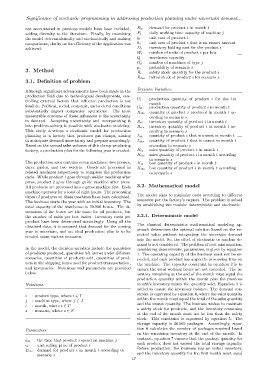
                                                              Decision Variables:
            Although significant advancements have been made in the
            production field due to technological developments, con-
            trolling external factors that influence production is not  U i  production quantity of product i for the 1st
            feasible. Political, social, economic, and societal conditions  month
                                                                   production quantity of product i in month t
                                                              U it
            substantially impact companies’ operations.  The most
                                                              X its  quantity of product i produced in month t ac-
            measurable outcome of these influences is the uncertainty  cording to scenario s
            in demand. Accepting uncertainty and incorporating it  inventory quantity of product i in month t
                                                              R it
            into problem-solving is possible with stochastic modeling.  inventory quantity of product i in month t ac-
                                                              R its
            This study develops a stochastic model for production  cording to scenario s
            planning in a factory that produces gas clamps, aiming  L it  quantity of product i that is unmet in month t
            to anticipate demand uncertainty and prepare accordingly.  L its  quantity of product i that is unmet in month t
            Based on the annual sales volumes of this clamp-producing  according to scenario s
            factory, a production plan for the following year is created.  N it  sales quantity of product i in month t
                                                              N its  sales quantity of product i in month t according
                                                                   to scenario s
            The production area contains seven machines: two presses,  box quantity of product i in month t
                                                              K it
            three guides, and two welders. Goods are processed in  box quantity of product i in month t according
                                                              K its
            related machines respectively to complete the production  to scenario s
            cycle. While product 1 goes through welder machines after
            press, product 2 goes through guide machine after press.
            All products are processed into a press machine first. Each  3.2. Mathematical model
            machine operates for a total of eight hours. The processing
                                                              The model aims to minimize costs according to different
            times of products on these machines have been calculated.
                                                              scenarios per the factory’s request. The problem is solved
            The business starts the year with an initial inventory. The
            total capacity of the warehouse is 30.000 boxes. The di-  by establishing two models: deterministic and stochastic.
            mensions of the boxes are the same for all products, but
            the number of units per box varies. Inventory costs per  3.2.1. Deterministic model
            product have been determined accordingly. Using all the
            obtained data, it is assumed that demand for the coming  The classical deterministic mathematical modeling ap-
            year is uncertain, and an ideal production plan is to be  proach determines the optimal solution based on the ex-
            created using various scenarios.                  pected value without integrating the uncertain demand
                                                              into the model. So, the effect of stochastic or random de-
                                                              mand is not considered. The problem of cost minimization,
            In the model, the decision variables include the quantities  considering deterministic parameters, is given by equation
            of products produced, quantities left unmet under different  1. The operating capacity of the business must not be ex-
            scenarios, quantities of products sold, quantities of prod-  ceeded, and each product has a specific processing time on
            ucts in the shipping boxes used for product transportation,  the machine. The capacity constraint in equation 2 is to
            and inventories. Notations and parameters are provided  ensure the total working hours are not exceeded. The in-
            below:                                            ventory remaining at the end of the month must equal the
                                                              production quantity within the month plus the previous
            Notations:                                        month’s inventory minus the quantity sold. Equation 3 is
                                                              added to ensure the inventory balance. The demand con-
                                                              straint is expressed by equation 4, where the sales quantity
            i  : product type, where i ∈ I
                                                              within the month must equal the total of the sales quantity
            j  : machine type, where j ∈ J
                                                              and the unmet quantity. The business wishes to maintain
            t  : month, where t ∈ T
                                                              a safety stock for products, and the inventory remaining
            s  : scenario, where s ∈ S
                                                              at the end of the month must not be less than the safety
                                                              stock. This constraint is expressed by equation 5. The
                                                              storage capacity is 30.000 packages. Accordingly, equa-
                                                              tion 6 calculates the number of packages required based
            Parameters:
                                                              on the remaining inventory at the end of the month. In
                                                              contrast, equation 7 ensures that the package quantity for
            a ij  the time that product i spend on machine j
                                                              each product does not exceed the total storage capacity.
            c i   unit selling price of product i
                                                              Before production, the business has an initial inventory,
            E its  demand for product i in month t according to
                                                              and the inventory quantity for the first month must equal
                  scenario s
                                                            17

