


Page 26 - IJOCTA-15-1
P. 26
S. Karahan Orak, N. Aydin, E. Karatas / IJOCTA, Vol.15, No.1, pp.14-24 (2025)

                                        Table 2. Monte Carlo Simulation N=5, m=10
             Cluster No      Product       Product       Product      Value of        Test      Gap
                                 1             2            3        Objective      result in
                                                                      Function       large
                                                                         (z)        sample
                                                                                      (Z)
                   1        23.098       30.341        20.810        -5.001.679   -5.019.889    18.209,91
                   2        20.970       29.681        22.461        -4.992.230   -5.019.852    27.621,80
                   3        22.193       30.090        21.512        -4.896.529   -5.019.885    123.355,77
                   4        20.675       34.577        22.690        -4.754.399   -5.020.083    265.683,96
                   5        20.862       34.945        22.545        -5.054.492   -5.020.103    -34.389,43
                   6        23.865       29.741        20.215        -5.039.257   -5.019.855    -19.402,07
                   7        23.687       35.231        20.353        -5.259.730   -5.020.119    -239.610,99
                   8        20.278       34.669        22.998        -4.936.899   -5.020.083    83.184,23
                   9        20.898       34.999        22.517        -4.954.620   -5.020.106    65.485,57
                  10        20.889       32.499        22.524        -5.048.848   -5.019.986    -28.861,94


            performed.


            As in Table 3 , increasing the number of scenarios within
            the clusters reduces the difference between z and Z. This
            result is displayed in the gap column. It is observed that
            increasing the number of scenarios improves the perfor-
            mance of the z values obtained within the large sample.


            As a result, the summary table named Table 4 was ob-
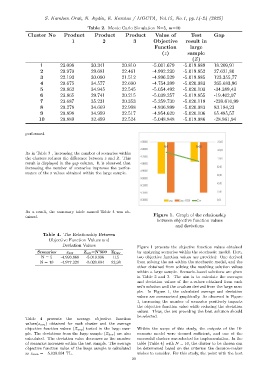
            tained.                                                  Figure 1. Graph of the relationship
                                                                       between objective function values
                                                                               and deviations
                    Table 4. The Relationship Between
                       Objective Function Values and
                             Deviation Values
                                                              Figure 1 presents the objective function values obtained
                  Scenarios    z avg  Z avg=N’500  Z Dev      by analyzing scenarios within the stochastic model. Here,
                   N = 5    -4.993.868  -5.019.996  115       two objective function values are provided: One derived
                   N = 10   -4.977.221  -5.020.004  92,98     from solving the set within the stochastic model, and the
                                                              other obtained from solving the resulting solution values
                                                              within a large sample. Scenario-based solutions are given
                                                              in Table 2 and 3. The aim is to calculate the averages
                                                              and deviation values of the z-values obtained from each
                                                              set’s solution and the z-values derived from the large sam-
                                                              ple.  In Figure 1, the calculated average and deviation
                                                              values are summarized graphically. As observed in Figure
                                                              1, increasing the number of scenarios positively impacts
                                                              the objective function value while reducing the deviation
                                                              values. Thus, the set providing the best solution should
                                                              be selected.
            Table  4  presents  the  average  objective  function
            values(z avg) obtained for each cluster and the average
            objective function values (Z avg) tested in the large sam-  Within the scope of this study, the outputs of the 10-
            ple. The deviations from the large sample (Z dev) are also  scenario model were deemed sufficient, and one of the
            calculated. The deviation value decreases as the number  successful clusters was selected for implementation. In the
            of scenarios increases within the test sample. The average  table (Table 4) with N = 10, the cluster to be chosen can
            objective function value of the large sample is calculated  be determined based on the criterion the decision-maker
            as z min = −5.020.004 TL.                         wishes to consider. For this study, the point with the best
                                                            20

