


Page 103 - IJOCTA-15-2
P. 103
A. Ebrahimzadeh, R. Khanduzi, A. Jajarmi / IJOCTA, Vol.15, No.2, pp.294-310 (2025)
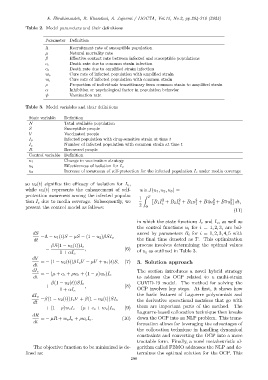
            Table 2. Model parameters and their definitions


                     Parameter Definition
                     Λ          Recruitment rate of susceptible population
                     µ          Natural mortality rate
                     β          Effective contact rate between infected and susceptible populations
                     c c        Death rate due to common strain infection
                     c v        Death rate due to amplified strain infection
                                Cure rate of infected population with amplified strain
                     w v
                     w c        Cure rate of infected population with common strain
                     ρ          Proportion of individuals transitionary from common strain to amplified strain
                     α          Inhibition or psychological factor in population behavior
                     ψ          Vaccination rate

            Table 3. Model variables and their definitions

              State variable  Definition
              N               Total available population
              S               Susceptible people
              V               Vaccinated people
                              Infected population with drug-sensitive strain at time t
              I v
              I c             Number of infected population with common strain at time t
              R               Recovered people
              Control variable Definition
              u 1             Change in vaccination strategy
              u 2             Effectiveness of isolation for I v
              u 3             Increase of awareness of self-protection for the infected population I c under media coverage

            so u 2 (t) signifies the efficacy of isolation for I v ,
            while u 3 (t) represents the enhancement of self-  min J(u 1 , u 2 , u 3 ) =
            protection awareness among the infected popula-      Z  T
                                                               1
                                                                         2
                                                                                                2
                                                                                2
                                                                                        2
            tion I c due to media coverage. Subsequently, we         B 1 I + B 2 I + B 3 u + B4u + B5u 2  dt,
                                                                         c
                                                                                                       3
                                                                                                2
                                                                                        1
                                                                                v
                                                               2
            present the control model as follows:                 0
                                                                                                         (11)
                                                              in which the state functions I c and I v , as well as
                                                              the control functions u i for i = 1, 2, 3, are bal-
                dS                                            anced by parameters B i for i = 1, 2, 3, 4, 5 with
                   =Λ − u 1 (t)S − µS − (1 − u 2 )βSI v
                dt                                            the final time denoted as T. This optimization
                                                              process involves determining the optimal values
                        βS(1 − u 3 (t))I c
                     −                 ,                (6)   of u as outlined in Table 3.
                            1 + αI c                              i
               dV
                   = − (1 − u 2 (t))βI v V − µV + u 1 (t)S,  (7)  3. Solution approach
                dt
               dI c                                           The section introduces a novel hybrid strategy
                   = − (µ + c c + ρw c + (1 − ρ)w c )I c
                dt                                            to address the OCP related to a multi-strain
                        β(1 − u 3 (t))SI c                    COVID-19 model. The method for solving the
                     +                 ,                (8)
                            1 + αI c                          OCP involves key steps. At first, it shows how
                                                              the basic features of Laguerre polynomials and
               dI v
                   =β(1 − u 2 (t))I v V + β(1 − u 2 (t))SI v  the derivative operational matrices that go with
                dt
                     + (1 − ρ)w c I c − (µ + c v + w v )I v ,  (9)  them are important parts of the method. The
                                                              Laguerre-based collocation technique then breaks
               dR
                   = − µR + w v I v + ρw c I c .       (10)   down the OCP into an NLP problem. This trans-
                dt
                                                              formation allows for leveraging the advantages of
                                                              the collocation technique in handling dynamical
                                                              constraints and converting the OCP into a more
                                                              tractable form. Finally, a novel metaheuristic al-
                The objective function to be minimized is de-  gorithm called FBMO addresses the NLP and de-
            fined as:                                         termines the optimal solution for the OCP. This
                                                           298

