


Page 106 - IJOCTA-15-2
P. 106
Collocation method with flood-based metaheuristic optimizer for optimal control ...
T
T
S(0) = S ϕ(0), V (0) = V ϕ(0), T Z 1 " T(s + 1) 2
T
= B 1 I ϕ( )
c
4 −1 2
T(s + 1) 2
T
T
T
I c (0) = I ϕ(0), I v (0) = I ϕ(0), (43) + B 2 I ϕ( )
v
c
v
2
T(s + 1) 2
T
+ B 3 U ϕ( ) (50)
1
T
R(0) = R ϕ(0). 2
2
T(s + 1)
T
+ B 4 U ϕ( )
2
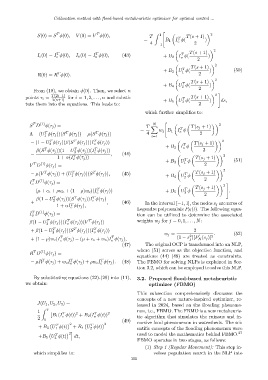
From (19), we obtain ϕ(0). Then, we select n 2
#
T(2i−1) 2
points τ i = for i = 1, 2, . . . , n and substi- T T(s + 1)
2(n+1) + B 5 U ϕ( ) ds,
tute them into the equations. This leads to: 3 2
which further simplifies to:
T
N
S D (1) ϕ(τ j ) = T X " T(s j + 1) 2
T
= w j B 1 I ϕ
c
T
T
T
Λ − (U ϕ(τ j ))(S ϕ(τ j )) − µ(S ϕ(τ j )) 4 i=1 2
1
T
T
T
− (1 − U ϕ(τ j ))β(S ϕ(τ j ))(I ϕ(τ j )) T(s j + 1) 2
2
v
T
+ B 2 I ϕ
v
T
T
T
β(S ϕ(τ j ))(1 − U ϕ(τ j ))(I ϕ(τ j )) 2
c
− 3 , (44) 2
T
1 + α(I ϕ(τ j )) + B 3 U ϕ T(s j + 1) (51)
c
T
T
V D (1) ϕ(τ j ) = 1 2
2
T
T
T
− µ(V ϕ(τ j )) + (U ϕ(τ j ))(S ϕ(τ j )), (45) + B 4 U ϕ T(s j + 1)
T
1
2
T
I D (1) ϕ(τ j ) = 2 #
c
T(s j + 1) 2
T
T
− (µ + c c + ρw c + (1 − ρ)w c )(I ϕ(τ j )) + B 5 U ϕ .
3
c
2
T
T
T
β(1 − U ϕ(τ j ))(S ϕ(τ j ))I ϕ(τ j )
c
+ 3 , (46) In the interval [−1, 1], the nodes s j are zeros of
T
1 + αI ϕ(τ j ),
c
Legendre polynomials P N (t). The following equa-
T
I D (1) ϕ(τ j ) = tion can be utilized to determine the associated
v
T
T
T
β(1 − U ϕ(τ j ))(I ϕ(τ j ))(V ϕ(τ j )) weights w j for j = 0, 1, . . . , N:
2
v
T
T
T
+ β(1 − U ϕ(τ j ))(S ϕ(τ j ))(I ϕ(τ j )) 2
v
2
w j = 2 ′ . (52)
T
T
+ (1 − ρ)w c (I ϕ(τ j ) − (µ + c v + w v )I ϕ(τ j ), (1 − s )[P (s j )] 2
N
j
c
v
(47) The original OCP is transformed into an NLP,
T
R D (1) ϕ(τ j ) = where (51) serves as the objective function, and
equations (44)–(48) are treated as constraints.
T
T
T
− µR ϕ(τ j ) + w v I ϕ(τ j ) + ρw c I ϕ(τ j ). (48) The FBMO for solving NLPs is explained in Sec-
v
c
tion 3.2, which can be employed to solve this NLP.
By substituting equations (22)-(29) into (11), 3.2. Proposed flood-based metaheuristic
we obtain: optimizer (FBMO)
This subsection comprehensively discusses the
concepts of a new nature-inspired optimizer, re-
J(U 1 , U 2 , U 3 ) = leased in 2024, based on the flooding phenome-
Z T
1 T 2 T 2 non, i.e., FBMO. The FBMO is a new metaheuris-
B 1 (I ϕ(t)) + B 2 (I ϕ(t))
v
c
2 0 (49) tic algorithm that simulates the ruinous and in-
cursive food phenomenon in watersheds. The sci-
T
T
+ B 3 U ϕ(t) 2 + B 4 U ϕ(t) 2 entific concepts of the flooding phenomenon were
1
2
i 27
2
T
+B 5 U ϕ(t) dt, used to model the mathematics behind FBMO.
3
FBMO operates in two stages, as follows:
(1) Step 1 (Regular Movement): This step in-
which simplifies to: volves population search in the NLP into
301

