


Page 111 - IJOCTA-15-2
P. 111
A. Ebrahimzadeh, R. Khanduzi, A. Jajarmi / IJOCTA, Vol.15, No.2, pp.294-310 (2025)
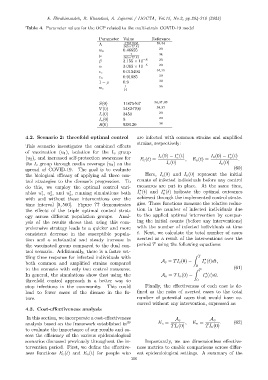
            Table 4. Parameter values for the OCP related to the multi-strain COVID-19 model

                                             Parameter Value        Reference
                                             Λ          37641835       33,34
                                                        365×77.43
                                             w v        0.46655         20
                                             µ             1            34
                                                        365×77.43
                                             β          3.155 × 10 −8   20
                                             α          3.063 × 10 −5   20
                                             c c        0.015494       34,35
                                                        0.91685         20
                                             c v
                                             1 − ρ      0.9             20
                                                        1               36
                                             w c
                                                        14
                                             S(0)       11875467      34,37,38
                                             V (0)      24824790       34,37
                                             I c (0)    3450            20
                                             I v (0)    8               20
                                             R(0)       938120          38


            4.2. Scenario 2: threefold optimal control        are infected with common strains and amplified
                                                              strains, respectively:
            This scenario investigates the combined effects
            of vaccination (u 1 ), isolation for the I v group                  ∗                      ∗
                                                                       I c (0) − I (t)         I v (0) − I (t)
            (u 2 ), and increased self-protection awareness for  E c (t) =     c   ,  E v (t) =        v   .
            the I c group through media coverage (u 3 ) on the             I c (0)                I v (0)
            spread of COVID-19.     The goal is to evaluate                                              (60)
            the biological efficacy of applying all three con-    Here, I c (0) and I v (0) represent the initial
            trol strategies to the disease’s progression. To  counts of infected individuals before any control
            do this, we employ the optimal control vari-      measures are put in place. At the same time,
                                                                          ∗
                                                               ∗
                   ∗
                       ∗
                                ∗
            ables u , u , and u , running simulations both    I (t) and I (t) indicate the optimal outcomes
                                                                         v
                                                               c
                                3
                   1
                       2
            with and without these interventions over the     achieved through the implemented control strate-
            time interval [0, 500].  Figure ?? demonstrates   gies. These functions measure the relative reduc-
            the effects of the triple optimal control strat-  tion in the number of infected individuals due
            egy across different population groups.   Anal-   to the applied optimal intervention by compar-
            ysis of the results shows that using this com-    ing the initial counts (before any interventions)
            prehensive strategy leads to a quicker and more   with the number of infected individuals at time
            consistent decrease in the susceptible popula-    t. Next, we calculate the total number of cases
            tion and a substantial and steady increase in     averted as a result of the interventions over the
            the vaccinated group compared to the dual con-    period T using the following equations:
            trol scenario. Additionally, there is a faster set-
            tling time response for infected individuals with                          Z  T
                                                                                            ∗
                                                                         A c = TI c (0) −  I (t)dt,
            both common and amplified strains compared                                      c
                                                                                        0
            to the scenario with only two control measures.                            Z  T              (61)
                                                                                            ∗
            In general, the simulations show that using the              A v = TI v (0) −  I (t)dt.
                                                                                            v
            threefold control approach is a better way to                               0
            stop infections in the community.    This could       Finally, the effectiveness of each case is de-
            lead to fewer cases of the disease in the fu-     fined as the ratio of averted cases to the total
            ture.                                             number of potential cases that would have oc-
                                                              curred without any intervention, expressed as:
            4.3. Cost-effectiveness analysis
             In this section, we incorporate a cost-effectiveness              A c            A v
            analysis based on the framework established in 39          E c =       ,  E v =        .     (62)
                                                                             TI c (0)       TI v (0)
            to evaluate the importance of our results and as-
            sess the efficiency of the various epidemiological
            scenarios discussed previously throughout the in-     Importantly, we use dimensionless effective-
            tervention period. First, we define the effective-  ness metrics to enable comparisons across differ-
            ness functions E c (t) and E v (t) for people who  ent epidemiological settings. A summary of the
                                                           306

