


Page 108 - IJOCTA-15-2
P. 108
Collocation method with flood-based metaheuristic optimizer for optimal control ...
            Initialize the sizes of the control parameters of the FBMO,
            i.e., the scaling element Ne, the maximum number of repetitions (Iter_{max}),
            the mass size (N_{pop}),
            and the repetition number (Iter=0) for the crowd.
            1: To generate the randomly initial swarm N_{pop} (i=1,...,N_{pop});
            2: U_{i}=U_{min}+rand*(U_{max}-U_{min})
            3: To compute the objective functional of the initial random mass;
            4: While the i till Iter_{max}, do
            5:    To arrange the repetitions, Iter=Iter+1;
            6:    for i=1 to N_{pop}, do
            7:         Pe_{i}=(J(U_{i})-J_{min}/J_{max}-J_{min})^2
            8:         if randG>rand+Pe_{i} then
            9:            U_{i}^{new}=U_{i}+(Pk^{rand}/Iter)*(rand*(U_{max}-U_{min})+U_{min})
            10:        else
            11:           U_{i}^{new}=U_{best}+rand*(U_{j}-U_{i})
            12:        end if
            13:        if J(U_{i}^{new})<J(U_{i}) then
            14:           U_{i}=U_{i}^{new} and J(U_{best})=J(U_{i});
            15:        end if
            16:        if J(U_{i})<J(U_{best}) then
            17:           U_{best}=U_{i} and J(U_{best})=J(U_{i});
            18:        end if
            19:   end for
            20:   if rand<Pt ; Pt=|sin(rand/Iter)| then
            21:       for e=1 to Ne, do
            22:           U_{e}^{new}=U_{best}+rand*(rand*(U_{max}-U_{min})+U_{min})
            23:           if J(U_{e}^{new}) < J(U_{best})
            24:               U_{best}=U_{e}^{new} and J(U_{best})=J(U_{e}^{new});
            25:           end if
            26:       end for
            27:   end if
            28: end while
            Output: U_{best}

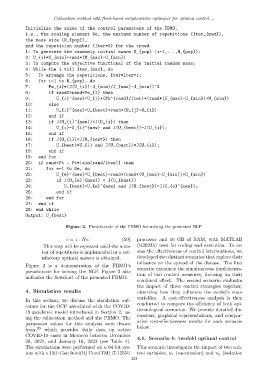
                              Figure 2. Pseudo-code of the FBMO for solving the presented NLP


                               e = 1 : Ne.             (59)   processor and 16 GB of RAM, with MATLAB
                    This step will be repeated until the num-  (R2023b) used for coding and execution. To as-
                    ber of repetitions is implemented or a sat-  sess the effectiveness of control interventions, we
                    isfactory optimal answer is obtained.     developed two distinct scenarios that explore their
                                                              influence on the spread of the disease. The first
            Figure 2 is a demonstration of the FBMO’s
                                                              scenario examines the simultaneous implementa-
            pseudo-code for solving the NLP. Figure 3 also
                                                              tion of two control measures, focusing on their
            indicates the flowchart of the presented FBMO.
                                                              combined effect. The second scenario evaluates
                                                              the impact of three control strategies together,
            4. Simulation results                             observing how they influence the model’s state
                                                              variables.  A cost-effectiveness analysis is then
            In this section, we discuss the simulation out-
            comes for the OCP associated with the COVID-      conducted to compare the efficiency of both epi-
            19 pandemic model introduced in Section 2, us-    demiological scenarios. We provide detailed dis-
            ing the collocation method and the FBMO. The      cussions, graphical representations, and compar-
                                                              ative cost-effectiveness results for each scenario
            parameter values for this analysis were drawn
            from, 20  which provides daily data on active     below.
            COVID-19 cases in Morocco between December
                                                              4.1. Scenario 1: twofold optimal control
            28, 2021, and January 16, 2022 (see Table 4).
            The simulations were performed on a 64-bit sys-   This scenario investigates the impact of two con-
            tem with a 12th Gen Intel(R) Core(TM) i7-1255U    trol variables, u 1 (vaccination) and u 2 (isolation
                                                           303

