


Page 131 - IJOCTA-15-2
P. 131
¨
                                E. Sonu¸c, E. Ozcan / IJOCTA, Vol.15, No.2, pp.311-329 (2025)


                                          Parametric Analysis: UFLP


                                     10   0.78     0.61     0.45      0.32          10.0
                                  ength (L)  20  0.55  0.46  0.34     0.33          7.5


                                  History List L  50 100  0.35  0.29  0.71  5.90    5.0


                                                                                    2.5
                                          0.44
                                                   0.73
                                                                       12.31
                                                            5.93
                                           4         8        16        32
                                              Number of Threads (nt)

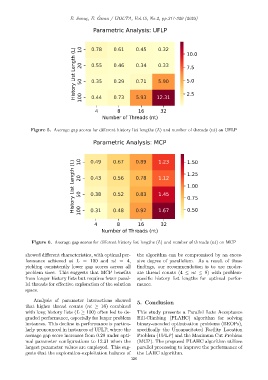
               Figure 5. Average gap scores for different history list lengths (L) and number of threads (nt) on UFLP


                                          Parametric Analysis: MCP


                                     10  0.49      0.67      0.89      1.23         1.50
                                  ength (L)  20  0.43  0.56  0.78      1.12         1.25


                                  History List L  50 100  0.38  0.52  0.83  1.45    1.00


                                                                                    0.75

                                                                                    0.50
                                                   0.48
                                         0.31
                                                             0.92
                                                                       1.67
                                           4         8        16        32
                                              Number of Threads (nt)

               Figure 6. Average gap scores for different history list lengths (L) and number of threads (nt) on MCP

            showed different characteristics, with optimal per-  the algorithm can be compromised by an exces-
            formance achieved at L = 100 and nt = 4,          sive degree of parallelism. As a result of these
            yielding consistently lower gap scores across all  findings, our recommendation is to use moder-
            problem sizes. This suggests that MCP benefits    ate thread counts (4 ≤ nt ≤ 8) with problem-
            from longer history lists but requires fewer paral-  specific history list lengths for optimal perfor-
            lel threads for effective exploration of the solution  mance.
            space.

                Analysis of parameter interactions showed     5. Conclusion
            that higher thread counts (nt ≥ 16) combined
            with long history lists (L ≥ 100) often led to de-  This study presents a Parallel Late Acceptance
            graded performance, especially for larger problem  Hill-Climbing (PLAHC) algorithm for solving
            instances. This decline in performance is particu-  binary-encoded optimization problems (BEOPs),
            larly pronounced in instances of UFLP, where the  specifically the Uncapacitated Facility Location
            average gap score increases from 0.29 under opti-  Problem (UFLP) and the Maximum Cut Problem
            mal parameter configurations to 12.31 when the    (MCP). The proposed PLAHC algorithm utilizes
            largest parameter values are employed. This sug-  parallel processing to improve the performance of
            gests that the exploration-exploitation balance of  the LAHC algorithm.
                                                           326

