


Page 126 - IJOCTA-15-2
P. 126
Parallel late acceptance hill-climbing for binary-encoded optimization problems
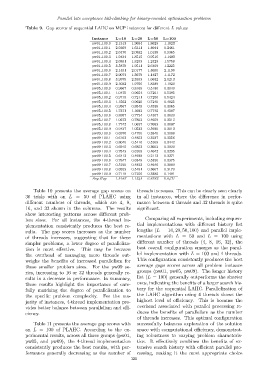
            Table 9. Gap scores of sequential LAHC on MCP instances for different L values

                                          Instance  L=10    L=20   L=50   L=100
                                          pw01 100.0  2.1313  1.9034  1.8623  1.1823
                                          pw01 100.1  2.9369  1.6311  1.4044  0.2461
                                          pw01 100.2  2.6476  2.0832  1.0138  0.9365
                                          pw01 100.3  1.9434  1.8515  0.9516  1.1403
                                          pw01 100.4  2.6891  1.8293  1.2423  1.5758
                                          pw01 100.5  3.5878  1.9511  2.6409  1.2225
                                          pw01 100.6  2.1491  2.0177  1.4090  2.1196
                                          pw01 100.7  2.9074  1.3679  1.1427  1.1172
                                          pw01 100.8  3.9975  2.3393  1.6632  2.0213
                                          pw01 100.9  2.1032  1.9766  1.8389  1.1920
                                          pw05 100.0  0.9667  0.8165  0.5186  0.3040
                                          pw05 100.1  1.0470  0.9654  0.7201  0.5395
                                          pw05 100.2  0.9715  0.7211  0.7256  0.5424
                                          pw05 100.3  1.1562  0.9620  0.7240  0.4825
                                          pw05 100.4  0.9567  0.8545  0.4538  0.3065
                                          pw05 100.5  1.7371  1.1033  0.7745  0.4587
                                          pw05 100.6  0.8957  0.7724  0.4357  0.3630
                                          pw05 100.7  1.0672  0.7803  0.4659  0.3512
                                          pw05 100.8  1.7742  1.0627  0.7083  0.3607
                                          pw05 100.9  0.9437  1.0532  0.5930  0.3013
                                          pw09 100.0  0.6976  0.4750  0.3340  0.2088
                                          pw09 100.1  0.6162  0.4852  0.3237  0.2556
                                          pw09 100.2  0.8040  0.5416  0.5269  0.3442
                                          pw09 100.3  0.6915  0.6852  0.3603  0.2920
                                          pw09 100.4  0.7543  0.6208  0.4042  0.3295
                                          pw09 100.5  0.6412  0.4938  0.2112  0.2271
                                          pw09 100.6  0.7847  0.6349  0.5320  0.3375
                                          pw09 100.7  0.5220  0.4822  0.4646  0.2889
                                          pw09 100.8  0.6553  0.5481  0.3607  0.2170
                                          pw09 100.9  0.7119  0.7256  0.3385  0.1491
                                          Avg.Gap   1.5163  1.1245  0.8382  0.6471

                Table 10 presents the average gap scores on   threads increases. This can be clearly seen clearly
            30 trials with an L = 50 of PLAHC using           in all instances, where the difference in perfor-
            different numbers of threads, which are 4, 8,     mance between 4 threads and 32 threads is quite
            16, and 32 shown in the columns. The results      significant.
            show interesting patterns across different prob-
            lem sizes.  For all instances, the 4-thread im-       Comparing all experiments, including sequen-
            plementation consistently produces the best re-   tial implementations with different history list
            sults. The gap scores increases as the number     lengths (L = 10, 20, 50, 100) and parallel imple-
            of threads increases, suggesting that for these   mentations with L = 50 and L = 100 using
            simpler problems, a lower degree of paralleliza-  different number of threads (4, 8, 16, 32), the
            tion is most effective.  This may be because      best overall configuration emerges as the paral-
            the overhead of managing more threads out-        lel implementation with L = 100 and 4 threads.
            weighs the benefits of increased parallelism for  This configuration consistently produces the best
            these smaller problem sizes. For the pw09 se-     average gaps scores across all problem instance
            ries, increasing to 16 or 32 threads generally re-  groups (pw01, pw05, pw09). The longer history
            sults in a decrease in performance. In summary,   list (L = 100) generally outperforms the shorter
            these results highlight the importance of care-   ones, indicating the benefits of a larger search his-
            fully matching the degree of parallelization to   tory for the sequential LAHC. Parallelization of
            the specific problem complexity.   For the ma-    the LAHC algorithm using 4 threads shows the
            jority of instances, 4-thread implementation pro-  highest level of efficiency. This is because the
            vides better balance between parallelism and effi-  overhead associated with parallel processing re-
            ciency.                                           duces the benefits of parallelism as the number
                                                              of threads increases. This optimal configuration
                Table 11 presents the average gap scores with  successfully balances exploration of the solution
            an L = 100 of PLAHC. According to the ex-         space with computational efficiency, demonstrat-
            perimental results, across all three groups (pw01,  ing robustness to varying problem characteris-
            pw05, and pw09), the 4-thread implementation      tics. It effectively combines the benefits of ex-
            consistently produces the best results, with per-  tensive search history with efficient parallel pro-
            formance generally decreasing as the number of    cessing, making it the most appropriate choice
                                                           321

