


Page 127 - IJOCTA-15-2
P. 127
¨
                                E. Sonu¸c, E. Ozcan / IJOCTA, Vol.15, No.2, pp.311-329 (2025)
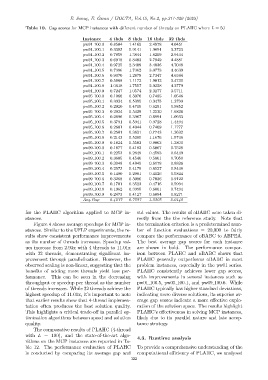
            Table 10. Gap scores for MCP instances with different number of threads on PLAHC where L = 50

                                      Instance    4 thds  8 thds  16 thds   32 thds
                                      pw01 100.0  0.8504  1.4165   2.4978    4.0451
                                      pw01 100.1  0.3383  0.9141   1.9694    3.3723
                                      pw01 100.2  0.7859  1.3844   1.8209    2.9444
                                      pw01 100.3  0.6918  0.8403   2.7949    4.4881
                                      pw01 100.4  0.9725  2.3409   3.4036    4.7048
                                      pw01 100.5  0.7386  1.7362   3.0773    4.4639
                                      pw01 100.6  0.9070  1.2879   2.7347    4.6344
                                      pw01 100.7  0.5868  1.1172   1.9012    3.4730
                                      pw01 100.8  1.0618  1.7557   2.9228    4.2779
                                      pw01 100.9  0.7247  1.0574   2.3277    3.5711
                                      pw05 100.0  0.1966  0.5076   0.7485    1.0546
                                      pw05 100.1  0.3924  0.5395   0.9475    1.2799
                                      pw05 100.2  0.2920  0.4715   0.6291    0.9852
                                      pw05 100.3  0.2924  0.5439   1.2520    1.6836
                                      pw05 100.4  0.2896  0.3967   0.6994    1.0933
                                      pw05 100.5  0.3791  0.5941   0.9728    1.4494
                                      pw05 100.6  0.2601  0.4044   0.7469    1.1777
                                      pw05 100.7  0.2501  0.3621   0.7743    1.2632
                                      pw05 100.8  0.2143  0.5285   1.1676    1.5746
                                      pw05 100.9  0.1824  0.5503   0.9063    1.3800
                                      pw09 100.0  0.1877  0.4183   0.5067    0.7528
                                      pw09 100.1  0.2253  0.2849   0.4593    0.6449
                                      pw09 100.2  0.3605  0.4546   0.5861    0.7050
                                      pw09 100.3  0.3048  0.4945   0.6178    0.8836
                                      pw09 100.4  0.2573  0.4179   0.6527    0.8448
                                      pw09 100.5  0.1490  0.2981   0.4126    0.5844
                                      pw09 100.6  0.3268  0.5086   0.7036    0.9122
                                      pw09 100.7  0.1701  0.3523   0.4716    0.5994
                                      pw09 100.8  0.1962  0.3995   0.6001    0.7494
                                      pw09 100.9  0.2473  0.4127   0.6094    0.8271
                                      Avg.Gap     0.4277  0.7597   1.3305    2.0140

            for the PLAHC algorithm applied to MCP in-        std values. The results of oBABC were taken di-
            stances.                                          rectly from the the reference study. Note that
                Figure 4 shows average speedups for MCP in-   the termination criterion is a predetermined num-
            stances. Similar to the UFLP experiments, the re-  ber of function evaluations = 20,000 to fairly
            sults show consistent performance improvements    compare the performance of oBABC to ABPEA.
            as the number of threads increases. Speedup val-  The best average gap scores for each instance
            ues increase from 2.93x with 4 threads to 11.01x  are shown in bold.   The performance compar-
            with 32 threads, demonstrating significant im-    ison between PLAHC and oBABC shows that
            provement through parallelization. However, the   PLAHC generally outperforms oBABC in most
            observed scaling is non-linear, suggesting that the  problem instances, especially in the pw01 series.
            benefits of adding more threads yield less per-   PLAHC consistently achieves lower gap scores,
            formance.   This can be seen in the decreasing    with improvements in several instances such as
            throughput or speedup per thread as the number    pw01 100.5, pw05 100.1, and pw09 100.6. While
            of threads increases. While 32 threads achieve the  PLAHC typically has higher standard deviations,
            highest speedup of 11.01x, it’s important to note  indicating more diverse solutions, its superior av-
            that earlier results show that 4-thread implemen-  erage gap scores indicate a more effective explo-
            tation often produces the best solution quality.  ration of the solution space. The results highlight
            This highlights a critical trade-off in parallel op-  PLAHC’s effectiveness in solving MCP instances,
            timization algorithms between speed and solution  likely due to its parallel nature and late accep-
            quality.                                          tance strategy.
                The comparative results of PLAHC (4-thread
            with L = 100), and the state-of-the-art algo-
                                                              4.3. Runtime analysis
            rithms on the MCP instances are reported in Ta-
            ble 12. The performance evaluation of PLAHC       To provide a comprehensive understanding of the
            is conducted by comparing its average gap and     computational efficiency of PLAHC, we analyzed
                                                           322

