


Page 130 - IJOCTA-15-2
P. 130
Parallel late acceptance hill-climbing for binary-encoded optimization problems
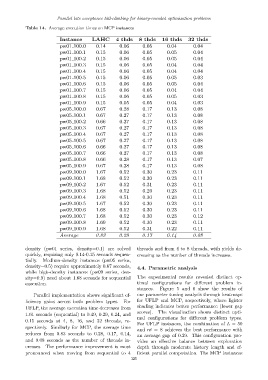
            Table 14. Average execution times on MCP instances

                            Instance      LAHC       4 thds    8 thds    16 thds     32 thds
                            pw01 100.0      0.14      0.06      0.05       0.04        0.04
                            pw01 100.1      0.15      0.06      0.05       0.05        0.04
                            pw01 100.2      0.15      0.06      0.05       0.05        0.04
                            pw01 100.3      0.15      0.06      0.05       0.04        0.04
                            pw01 100.4      0.15      0.06      0.05       0.04        0.04
                            pw01 100.5      0.15      0.06      0.05       0.05        0.03
                            pw01 100.6      0.15      0.06      0.05       0.05        0.04
                            pw01 100.7      0.15      0.06      0.05       0.04        0.04
                            pw01 100.8      0.15      0.06      0.05       0.05        0.03
                            pw01 100.9      0.15      0.05      0.05       0.04        0.03
                            pw05 100.0      0.67      0.28      0.17       0.13        0.08
                            pw05 100.1      0.67      0.27      0.17       0.13        0.08
                            pw05 100.2      0.66      0.27      0.17       0.13        0.08
                            pw05 100.3      0.67      0.27      0.17       0.13        0.08
                            pw05 100.4      0.67      0.27      0.17       0.13        0.08
                            pw05 100.5      0.67      0.27      0.17       0.13        0.08
                            pw05 100.6      0.66      0.27      0.17       0.13        0.08
                            pw05 100.7      0.66      0.27      0.17       0.13        0.08
                            pw05 100.8      0.66      0.28      0.17       0.13        0.07
                            pw05 100.9      0.67      0.28      0.17       0.13        0.08
                            pw09 100.0      1.67      0.52      0.30       0.23        0.11
                            pw09 100.1      1.68      0.52      0.30       0.23        0.11
                            pw09 100.2      1.67      0.52      0.31       0.23        0.11
                            pw09 100.3      1.68      0.52      0.29       0.23        0.11
                            pw09 100.4      1.68      0.51      0.30       0.23        0.11
                            pw09 100.5      1.67      0.52      0.30       0.23        0.11
                            pw09 100.6      1.68      0.52      0.30       0.23        0.11
                            pw09 100.7      1.68      0.52      0.30       0.23        0.12
                            pw09 100.8      1.69      0.52      0.30       0.23        0.11
                            pw09 100.9      1.68      0.52      0.31       0.22        0.11
                            Average         0.83      0.28      0.17       0.14        0.08

            density (pw01 series, density=0.1) are solved     threads and from 4 to 8 threads, with yields de-
            quickly, requiring only 0.14-0.15 seconds sequen-  creasing as the number of threads increases.
            tially.  Medium-density instances (pw05 series,
            density=0.5) require approximately 0.67 seconds,  4.4. Parametric analysis
            while high-density instances (pw09 series, den-
            sity=0.9) need about 1.68 seconds for sequential  The experimental results revealed distinct op-
            execution.                                        timal configurations for different problem in-
                                                              stances.  Figure 5 and 6 show the results of
                Parallel implementation shows significant ef-  our parameter tuning analysis through heatmaps
            ficiency gains across both problem types.   For   for UFLP and MCP, respectively, where lighter
            UFLP, the average execution time decreases from   shading indicates better performance (lower gap
                                                              scores).  The visualization shows distinct opti-
            1.61 seconds (sequential) to 0.49, 0.29, 0.24, and
                                                              mal configurations for different problem types.
            0.15 seconds at 4, 8, 16, and 32 threads, re-
                                                              For UFLP instances, the combination of L = 50
            spectively. Similarly for MCP, the average time
                                                              and nt = 8 achieves the best performance with
            reduces from 0.83 seconds to 0.28, 0.17, 0.14,
                                                              an average gap of 0.29. This configuration pro-
            and 0.08 seconds as the number of threads in-     vides an effective balance between exploration
            creases. The performance improvement is most      depth through moderate history length and ef-
            pronounced when moving from sequential to 4       ficient parallel computation. The MCP instances
                                                           325

