Page 180 - IJOCTA-15-2
P. 180

An investigation on the optimality condition of Caputo fractional time delay system
            6. Pontryagin maximum principle
                (PMP)                                                            1               2
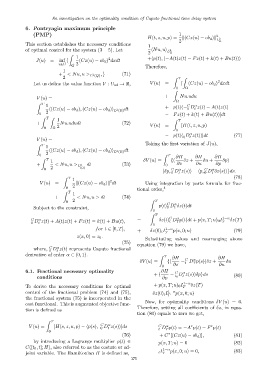
                                                                   H(t, z, u, p) = ∥(Cz(u) − ob d )∥ 2
                                                                                                 L
                                                                                 2                Ω
            This section establishes the necessary conditions
                                                                   1
            of optimal control for the system (3 − 5). Let          ⟨Nu, u⟩ 2
                                                                           L
                                                                   2        Ω
                                   1                               +⟨p(t), (−A(t)z(t) − Fz(t) + k(t) + Bu(t))⟩
                                Z
                                                 2
                 J(u) =    inf {    (Cz(u) − ob d ) dxdt
                           u∈U     2
                                 Q                                Therefore,
                             1
                           + < Nu, u > 2      , }      (71)
                                         L (Q)
                             2                                                Z  T  Z
                                                                                                  2
                Let us define the value function V : U ad → R,      V (u) =       [  (Cz(u) − ob d ) dxdt
                                                                               0   Ω
                                                                              Z
                                                                          +      Nu.udu
                 V (u) =
                                                                               Ω
                   T
                 Z
                                                                                       α
                     1                                                    + p(t)(− D z(t) − A(t)z(t)
                                                                                    C
                       ⟨(Cz(u) − ob d ), (Cz(u) − ob d )⟩ 2  dt                     0  t
                                                    L (Ω)
                     2
                   0                                                      − Fz(t) + k(t) + Bu(t))]dt
                      T   1                                                   Z  T
                   Z   Z
                 +          Nu.ududt                   (72)         V (u) =       [H(t, z, u, p)
                     0  Ω  2
                                                                               0
                                                                                     α
                                                                          − p(t)( D z(t))]dt             (77)
                                                                                     t
                                                                                  0
                 V (u) =
                                                                  Taking the first variation of J(u),
                 Z  T
                     1
                       ⟨(Cz(u) − ob d ), (Cz(u) − ob d )⟩ 2  dt
                                                    L (Ω)
                     2
                   0                                                     Z  T  ∂H       ∂H      ∂H
                   Z  T  1                                       δV (u) =    {(    δz +    δu +     δp)
                 +       < Nu, u > 2    dt             (73)                0    ∂z      ∂u       ∂p
                                   L
                     0  2            (Ω)                                     C  α           C  α
                                                                       − ⟨δp, D z(s)⟩ − ⟨p, D δz(s)⟩}ds.
                                                                                               t
                                                                                t
                                                                             0
                                                                                            0
                               T  1
                             Z                                                                           (78)
                                                  2
                   V (u) =         ∥(Cz(u) − ob d )∥ dt           Using integration by parts formula for frac-
                              0  2                            tional order, 4
                               T  1
                             Z
                         +         < Nu, u > dt        (74)
                              0  2                                  Z  T   C  α
                                                                        p(t) D δz(t)dt
                Subject to the constraint,                                 0  t
                                                                     0
                                                                    Z  T
                                                                                α
                                                                            C
               C  α                                           =         δz(t) D p(t)dt + p(x, T; u) 0 I 1−α δz(T)
                  t
               0  D z(t) + A(t)z(t) + Fz(t) = k(t) + Bu(t),                 t  T                    T
                                                                     0
                                           for t ∈ [0, T],    +     δz(0) t I 1−α p(x, 0; u)             (79)
                                                                          T
                                   z(x, 0) = z 0 .
                                                                  Substituting values and rearranging above
                                                       (75)
                                                              equation (79) we have,
                          α
                where,  C D z(t) represents Caputo fractional
                          t
                       0
            derivative of order α ∈ (0, 1).                             Z  T  ∂H                  ∂H
                                                                                   C
                                                                                       α
                                                               δV (u) =    {(    − D p(s))δz +       δu
                                                                                   t
                                                                                       T
                                                                         0    ∂z                  ∂u
            6.1. Fractional necessary optimality                         ∂H    C  α
                                                                     + (     − D z(s))δp}ds              (80)
                                                                                  t
                 conditions                                              ∂p    t 0
            To derive the necessary conditions for optimal           + p(x, T; u) 0 I T 1−α δz(T)
            control of the fractional problem (74) and (75),         δz(0) t I T 1−α p(x, 0; u)
            the fractional system (75) is incorporated in the
            cost functional. This is augmented objective func-    Now, for optimality conditions δV (u) = 0.
            tion is defined as                                Therefore, setting all coefficients of δz, in equa-
                                                              tion (80) equals to zero we get,
                        T
                     Z
                                                 α
                                                                                      ∗
                                                                                               ∗
              V (u) =    [H(s, z, u, p) − ⟨p(s),  C D z(s)⟩]ds         C D p(t) = −A p(t) − F p(t)
                                                                           α
                                                 t
                                              0
                       0                                               t   T
                                                                            ∗
                                                       (76)             + C [(Cz(u) − ob d )],           (81)
                by introducing a Lagrange multiplier p(t) ∈            p(x, T; u) = 0                    (82)
            C([t 0 , t]; H), also referred to as the costate or ad-      1−α
                                                                       t I   p(x, 0; u) = 0,             (83)
            joint variable. The Hamiltonian H is defined as,             T
                                                           375
   175   176   177   178   179   180   181   182   183   184   185