


Page 176 - IJOCTA-15-2
P. 176
An investigation on the optimality condition of Caputo fractional time delay system
∞
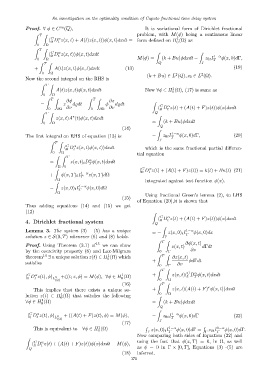
Proof. ∀ ϕ ∈ C (Q), It is variational form of Dirichlet fractional
Z T Z problem, with M(ϕ) being a continuous linear
α
C
1
( D z(x, t) + A(t)z(x, t))ϕ(x, t)dxdt = form defined on H (Ω) as
0
t
0
0 Ω
T
Z Z
C
α
( D z(x, t))ϕ(x, t)dxdt Z Z 1−α
t
0
0 Ω M(ϕ) = (k + Bu)ϕdxdt − z 0t I T ϕ(x, 0)dΓ,
T
Z Z Q Γ
+ A(t)z(x, t)ϕ(x, t)dxdt (13) (19)
0 Ω 2 2
(k + Bu) ∈ L (Q), z 0 ∈ L (Ω).
Now the second integral on the RHS is
T
Z Z
1
A(t)z(x, t)ϕ(x, t)dxdt Now ∀ϕ ∈ H (Ω), (17) is same as
0
0 Ω
T ∂ϕ T ∂z
Z Z Z Z
= z dϱdt − ϕ dϱdt Z C α
0 ∂Ω ∂ν 0 ∂Ω ∂ν ( D z(t) + (A(t) + F)z(t))ϕ(x)dxdt
0
t
Z T Z Q
∗
z(x, t)A (t)ϕ(x, t)dxdt Z
0 Ω = (k + Bu)ϕdxdt
Q
(14)
Z
The first integral on RHS of equation (13) is − z 0t I T 1−α ϕ(x, 0)dΓ, (20)
Γ
Z T Z
α
C
( D z(x, t)ϕ(x, t))dxdt which is the same fractional partial differen-
0
t
0 Ω tial equation
T
Z Z
α
= z(x, t) t D ϕ(x, t)dxdt
T
Ω 0
( D z(t) + (A(t) + F)z(t)) = k(t) + Bu(t) (21)
Z C α
0
t
+ ϕ(x, T) 0 I 1−α z(x, T)dΩ
T
Ω integrated against test function ϕ(x).
Z
− z(x, 0) t I 1−α ϕ(x, 0)dΩ
T
Ω
Using fractional Green’s lemma (2), to LHS
(15)
of Equation (20),it is shown that
Thus adding equations (14) and (15) we get
(12)
Z
α
C
( D z(t) + (A(t) + F)z(t))ϕ(x)dxdt
0
t
4. Dirichlet fractional system Q
Z
Lemma 3. The system (3) − (5) has a unique = − z(x, 0) t I 1−α ϕ(x, 0)dx
solution z ∈ S(0, T) whenever (6) and (8) holds. Γ T
Z T Z ∂ϕ(x, t)
Proof. Using Theorem (3.1) of 15 we can show − z(x, t) dΓdt
by the coercivity property (8) and Lax-Milgram 0 Γ ∂ν
1
theorem 14 ∃ a unique solution z(t) ∈ H (Ω) which Z T Z ∂z(x, t)
0
satisfies + ∂ν ϕdΓdt
0 Γ
T C α
Z Z
1
α
C
( D z(t), ϕ) 2 +ζ(t; z, ϕ) = M(ϕ), ∀ϕ ∈ H (Ω) + z(x, t)( D ϕ(x, t)dxdt
T
t
0
L
t
0
(Q) 0 Ω
(16) Z T Z ∗
This implies that there exists a unique so- + z(x, t)(A(t) + F) ϕ(x, t))dxdt
1
lution z(t) ∈ H (Ω) that satisfies the following 0 Ω
0 Z
1
∀ϕ ∈ H (Ω) = (k + Bu)ϕdxdt
0
Q
Z
C α 1−α
( D z(t), ϕ) 2 + ((A(t) + F)z(t), ϕ) = M(ϕ), − z 0t I T ϕ(x, 0)dΓ (22)
0
L
t
(Q) Γ
(17)
1
This is equivalent to ∀ϕ ∈ H (Ω) R 1−α R 1−α
0 z(x, 0) t I ϕ(x, 0)dΓ = z 0t I ϕ(x, 0)dΓ.
Γ T Γ T
Now comparing both sides of Equation (22) and
Z
α
C
( D z(t) + (A(t) + F)z(t))ϕ(x)dxdt = M(ϕ), using the fact that ϕ(x, T) = 0, in Ω, as well
t
0
Q as ϕ = 0 in Γ × [0, T], Equations (3) -(5) are
(18) inferred.
371

