


Page 36 - IJOCTA-15-2
P. 36
Analyzing the Black-Scholes equation with fractional coordinate derivatives using . . .
By multiplying 2λ on both sides of Eq. (33), where i = 0, 1, 2, · · · , M x and n = 1, 2, · · · , N t .
β
we have Now, for n = 1 and considering b = 1, we have
0
n−1 (Ω + Ψ)U + (1 + 2Ω + Φ)U + (−Ω − Ψ)U
1 1 1
β n n−1 X β β l l−1 i−1 i i+1
b U + U − b − b U + U
0 i i n−l−1 n−l i i 0 0
l=1 = (−Ω − Ψ)U i−1 + (−1 − 2Ω − Φ)U i
Aλ 1
β 0 n n n n−1 0 0
− 2b n−1 i h 2 U i+1 − 2U − U i−1 + U i+1 + (Ω + Ψ)U i+1 + 2U + 2λf ,
U =
2
i
i
i
i = 0, 1, 2, · · · , M x .
Gλ n n n−1
n−1
n−1
− 2U − U ) + U − U + U
i i−1 i+1 i−1 i+1 (42)
2h
n
n
− U n−1 ) − Hλ U + U n−1 + λ f + f n−1 , n n
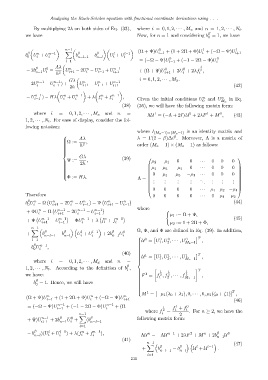
i−1 i i i i Given the initial conditions U 0 and U M x in Eq.
(38) (36), we will have the following matrix form:
where i = 0, 1, 2, · · · , M x and n = 1 0 1 1
ΛU = (−Λ + 2I) U + 2λF + M , (43)
1, 2, · · · , N t . For ease of display, consider the fol-
lowing notation:
where I (M x−1)×(M x−1) is an identity matrix and
Aλ λ = Γ(2 − β)∆t . Moreover, Λ is a matrix of
β
Ω := ,
h
2 order (M x − 1) × (M x − 1) as follows:
Gλ
Ψ := , (39) 0 0 · · · 0 0 0
2h µ 2 −µ 1
µ µ 2 −µ 1 0 · · · 0 0 0
1
0 −µ 1 · · · 0 0
µ 1 µ 2 0
Φ := Hλ. Λ = . . . . . . .
. . . . . . . . . . . . . . . .
.
0 0 0 0 · · · µ 1 µ 2 −µ 1
Therefore 0 0 0 0 · · · 0 µ 1 µ 2
β n n n n n n (44)
b U − Ω U − 2U − U − Ψ U − U
0 i i+1 i i−1 i+1 i−1
where
n−1
n−1
n
n−1
+ ΦU = Ω U i+1 − 2U i − U i−1 ( µ 1 := Ω + Ψ,
i
n
+ Ψ U n−1 − U n−1 − ΦU n−1 + λ f + f n−1 (45)
i+1 i−1 i i i µ 2 := 1 + 2Ω + Φ,
n−1
X β β l l−1 β 0 Ω, Ψ, and Φ are defined in Eq. (39). In addition,
+ b − b U + U + 2b U
n−l−1 n−l i i n−1 i
T
0
0
0
0
l=1 U = U , U , · · · , U M x−1 ,
2
1
β n−1
− b U ,
0 i
(40) T
1 1 1 1 ,
U = U , U , · · · , U
where i = 0, 1, 2, · · · , M x and n = 1 2 M x−1
β
1, 2, · · · , N t . According to the definition of b ,
l T
1 1 1
1
we have: F = f , f , · · · , f 2 ,
2
2
1 2 M x−1
β
b = 1. Hence, we will have
0
M = [−µ 1 (λ 0 + λ 1 ), 0, · · · , 0, µ 1 (ζ 0 + ζ1)] ,
1 T
n
n
n
(Ω + Ψ)U i−1 + (1 + 2Ω + Φ)U + (−Ω − Ψ)U i+1 (46)
i
n−1
= (−Ω − Ψ)U i−1 + (−1 − 2Ω − Φ)U i n−1 + (Ω 1 f + f 0
1
where f 2 = i i . For n ≥ 2, we have the
n−1 i 2
X
0
+ Ψ)U n−1 + 2b β U + (b β following matrix form:
i+1 n−1 i n−l−1
l=1
β l l−1 n n−1
− b )(U + U ) + λ(f + f ), n n−1 2 n β 0
n−l i i i i ΛU = −ΛU + 2λF + M + 2b n−1 U
(41)
(47)
n−1
X β β l l−1
+ b − b U + U .
n−l−1 n−l
l=1
231

