


Page 45 - IJOCTA-15-2
P. 45
M. M. Parsa, K. Sayevand, H. Jafari, I. Masti / IJOCTA, Vol.15, No.2, pp.225-244 (2025)

                           β = 0.4                          β = 0.5                          β = 0.6
                1                                1                                1
                0.8                              0.8                             0.8
               v(s,τ) 0.6                       v(s,τ) 0.6 0.4                   v(s,τ) 0.6
                                                                                 0.4
                0.4
                0.2                              0.2                             0.2
                0                                0                                0
                1                                1                                1
                                        1                                1                               1
                                     0.8                              0.8                              0.8
                     0.5           0.6               0.5            0.6               0.5           0.6
                                0.4                              0.4                              0.4
                              0.2                              0.2                             0.2
                      τ   0  0  s                      τ   0  0  s                     τ   0  0  s
                                                            β = 0.7
                                                 1
                                                 0.8
                                                v(s,τ) 0.6 0.4
                                                 0.2
                                                 0
                                                 1
                                                                         1
                                                                      0.8
                                                     0.5            0.6
                                                                 0.4
                                                               0.2
                                                       τ   0  0  s
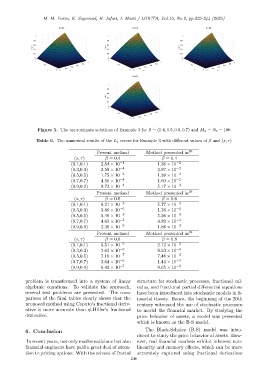
                  Figure 5. The approximate solutions of Example 3 for β = (0.4, 0.5, 0.6, 0.7) and M x = N t = 100
                 Table 6. The numerical results of the L 1 errors for Example 3 with different values of β and (s, τ)

                                            Present method        Method presented in 39
                                  (s, τ)        β = 0.4                  β = 0.4
                                 (0.1,0.1)    2.84 × 10 −4             1.36 × 10 −2
                                 (0.3,0.3)    3.59 × 10 −4             2.97 × 10 −2
                                 (0.5,0.5)    1.75 × 10 −3             1.38 × 10 −3
                                 (0.7,0.7)    4.56 × 10 −4             1.60 × 10 −2
                                 (0.9,0.9)    9.72 × 10 −4             5.17 × 10 −3
                                            Present method        Method presented in 39
                                  (s, τ)        β = 0.6                  β = 0.6
                                 (0.1,0.1)    6.21 × 10 −5             5.77 × 10 −3
                                 (0.3,0.3)    3.86 × 10 −6             1.76 × 10 −2
                                 (0.5,0.5)    5.46 × 10 −5             5.56 × 10 −3
                                 (0.7,0.7)    4.63 × 10 −5             4.89 × 10 −3
                                 (0.9,0.9)    2.36 × 10 −6             1.86 × 10 −3
                                            Present method        Method presented in 39
                                  (s, τ)        β = 0.8                  β = 0.8
                                 (0.1,0.1)    5.51 × 10 −6             2.12 × 10 −3
                                 (0.3,0.3)    7.63 × 10 −6             9.53 × 10 −3
                                 (0.5,0.5)    7.16 × 10 −7             7.46 × 10 −3
                                 (0.7,0.7)    3.64 × 10 −6             1.44 × 10 −3
                                 (0.9,0.9)    6.43 × 10 −7             9.65 × 10 −3

            problem is transformed into a system of linear    structure for stochastic processes, fractional cal-
            algebraic equations. To validate the approach,    culus, and fractional partial differential equations
            several test problems are presented. The com-     have been introduced into stochastic models in fi-
            parison of the final tables clearly shows that the  nancial theory. Hence, the beginning of the 20th
            proposed method using Caputo’s fractional deriv-  century witnessed the use of stochastic processes
            ative is more accurate than ψ-Hilfer’s fractional  to model the financial market. By studying the
            derivative.                                       price behavior of assets, a model was presented
                                                              which is known as the B-S model.
            6. Conclusion                                         The Black-Scholes (B-S) model was intro-
                                                              duced to study the price behavior of assets. How-
             In recent years, not only mathematicians but also  ever, real financial markets exhibit inherent non-
            financial engineers have paid a great deal of atten-  linearity and memory effects, which can be more
            tion to pricing options. With the advent of fractal  accurately captured using fractional derivatives
                                                           240

