


Page 42 - IJOCTA-15-2
P. 42
Analyzing the Black-Scholes equation with fractional coordinate derivatives using . . .
            where γ = max{1, η}. We know that if i > j,           where (x, t) ∈ (0, 1) × (0, 1), r = 0.05, σ =
                                  β                                      2           2
                                 b                                      σ           σ
                  β    β          i
            then b > b . Hence,   β  ≤ 1. Therefore           0.25, A =   , B = r−     and C = r, u(0, t) = 0,
                  j
                       i
                                 b                                       2          2 2
                                  j                           u(1, t) = 0, u(x, 0) = x (1 − x) and
                       1
                    γ|r |t       n−1   β      β
               n
                                  X
             |s | ≤        −1 + 2      b n−l−1  − b n−l
                    b β
                     n−1          l=1                                      2t 2−β     2t 1−β
                                                                                               2
                                                               f(x, t) = (        +          )x (1 − x)
                           1         n−1
                 β       γ|r |         X     β        β                  Γ(3 − β)   Γ(2 − β)
              + b     ≤        −1 + 2       b      − b
                 n−1      β                  n−l−1    n−l               2                       2       (136)
                         b                                      − (t + 1) (A(2 − 6x) + B(2x − 3x )
                          n−1           l=1
                                                                   2
                 β                                              − Cx (1 − x)).
              + b      .
                 n−1
                                                      (129)
            Consequently from Lemma 4, we have                    In this case, by considering β = 0.75, the
                                    γ                         exact solution of the equation will be u(x, t) =
                                         1
                              n
                            |s | ≤  β  |r |,          (130)   (x(t + 1)) (1 − x).
                                                                       2
                                   b n−1
            which completes the proof.
            Theorem 5. The numerical scheme (41) for
            solving the TFB-S model is convergent and the         To measure the accuracy of the method, we
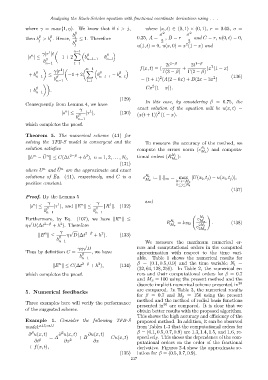
            solution satisfies                                compute the errors norm (e  N t  ) and computa-
                                                                                          M x
                    b n
                                       2
                n
             ∥U − U ∥ ≤ C(∆t    2−β  + h ), n = 1, 2, . . . , N t ,  tional orders (R N t  ):
                                                                             M x
                                                      (131)
                           b n
            where U n  and U  are the approximate and exact
            solutions of Eq. (41), respectively, and C is a      e N t  := ∥.∥ ∞ = max |U(x i , t j ) − u(x i , t j )|,
                                                                  M x
            positive constant.                                                 0≤i≤M x
                                                                               0≤j≤N t
                                                                                                        (137)
            Proof. By the Lemma 5
                      γ    1         n      γ     1               and
                n
              |s | ≤  β  |r |, and ∥E ∥ ≤  β   ∥R ∥. (132)
                     b                    b
                      n−1                  n−1
                                                                                             !
                                                      n
            Furthermore, by Eq.    (107), we have ∥R ∥ ≤                                 e N t
              √                                                            R N t          M x  .        (138)
                            2
            η D(∆t   2−β  + h ). Therefore                                   M x  = log 2  e 2N t
                            γ   √                                                        2M x
                                              2
                     n
                  ∥E ∥ ≤       η D(∆t  2−β  + h ).    (133)
                          b β
                           n−1                                    We measure the maximum numerical er-
                                      √
                                   γη D                       rors and computational orders in the computed
            Thus by definition C =   β    , we have           approximation with respect to the time vari-
                                    b n−1                     able.  Table 1 shows the numerical results for
                                             2
                           n
                        ∥E ∥ ≤ C(∆t  2−β  + h ),      (134)   β = (0.1, 0.5, 0.9) and the time variable N t =
                                                              (32, 64, 128, 256). In Table 2, the numerical er-
            which completes the proof.                        rors and their computational orders for β = 0.7
                                                              and M x = 100 using the present method and the
                                                              discrete implicit numerical scheme presented in 36
                                                              are compared. In Table 3, the numerical results
            5. Numerical feedbacks
                                                              for β = 0.7 and M x = 150 using the present
                                                              method and the method of radial basis functions
            Three examples here will verify the performance               30
                                                              presented in  are compared. It is clear that we
            of the suggested scheme.                          obtain better results with the proposed algorithm.
                                                              This shows the high accuracy and efficiency of the
            Example 1. Consider the following TFB-S           proposed method. In addition, it can be observed
            model: a13,ex11                                   from Tables 1-3 that the computational orders for
               β
                            2
              ∂ u(x, t)    ∂ u(x, t)    ∂u(x, t)              β = (0.1, 0.5, 0.7, 0.9) are 1.3, 1.4, 1.5, and 1.6, re-
                       = A          + B         − Cu(x, t)    spectively. This shows the dependence of the com-
                ∂t β         ∂x 2          ∂x                 putational orders on the order of the fractional
              + f(x, t),                                      derivative. Figures 2-4 show the approximate so-
                                                      (135)   lution for β = (0.5, 0.7, 0.9).
                                                           237

