


Page 70 - IJOCTA-15-2
P. 70
Hybridizing biogeography-based optimization and integer programming for solving the travelling tournament ...
            while adhering to constraints such as limiting con-  (1) Double Round Robin Constraint
            secutive home or away games to a maximum of              (DRRT): Each team must play against
            three.  This problem is classified as NP-hard,           every other team twice—once at their own
            with its complexity established through a reduc-         venue and once at the opponent’s venue.
            tion from the 3-satisfiability (3-SAT) problem. 7        Teams participate in one match per day,
            This reduction underscores that the problem re-          without any breaks, ensuring a game is
            mains strongly NP-hard even when the restriction         held daily.
            on consecutive away games is capped at three.        (2) No team is permitted to have more than
            Additionally, the Unconstrained Traveling Tour-          three consecutive matches at home or
            nament Problem (UTTP), which removes con-                away.
            straints on consecutive home or away games, con-     (3) Teams are not permitted to face the same
            tinues to pose an NP-hard challenge. 8                   opponent in consecutive matches.
                TTP presents both theoretical and practical
            challenges. It combines elements of the travel-       The Unconstrained Traveling Tournament
            ing salesman problem with those of tournament     Problem (UTTP) is a variation of the TTP
            scheduling, creating significant feasibility diffi-  that removes constraints two and three.   It
            culties due to its structured format, along with  is often relevant for practical scheduling, espe-
            complex optimization issues related to travel dis-  cially in low-budget league sports.  Let R =
            tances. Given this blend of characteristics, TTP  (R 1 , R 2 , . . . , R 2(2n−1) ) represent the sequence of
            has proven challenging to solve exactly, even for  2(2n − 1) days, from round R 1 to round R 2(2n−1) .
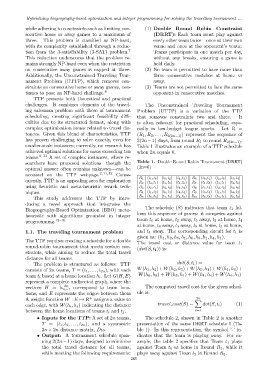
            smaller-scale instances; currently, no research has  Table 1 illustrates an example of a TTP schedule
            achieved optimal solutions for cases exceeding ten  when 2n equals 6.
            teams. 9–11  A set of complex instances, where re-
            searchers have proposed solutions—though the      Table 1. Double Round Robin Tournament (DRRT)
                                                              (2n=6)
            optimal answer often remains unknown—can be
            accessed on the TTP webpage.     2,11,12  Conse-
                                                               R 1  (t 1 , t 6 ) (t 5 , t 2 ) (t 4 , t 3 )  R 6  (t 6 , t 1 ) (t 2 , t 5 ) (t 3 , t 4 )
            quently, TTP is an appealing area for exploration
                                                               R 2  (t 2 , t 1 ) (t 3 , t 5 ) (t 4 , t 6 )  R 7  (t 4 , t 5 ) (t 3 , t 1 ) (t 2 , t 6 )
            using heuristic and meta-heuristic search tech-    R 3  (t 5 , t 1 ) (t 2 , t 4 ) (t 6 , t 3 )  R 8  (t 1 , t 5 ) (t 4 , t 2 ) (t 3 , t 6 )
            niques.                                            R 4  (t 1 , t 2 ) (t 5 , t 3 ) (t 6 , t 4 )  R 9  (t 5 , t 4 ) (t 1 , t 3 ) (t 6 , t 2 )
                This study addresses the TTP by intro-         R 5  (t 5 , t 6 ) (t 1 , t 4 ) (t 2 , t 3 )  R 10  (t 6 , t 5 ) (t 4 , t 1 ) (t 3 , t 2 )
            ducing a novel approach that integrates the
                                                                  The schedule (S) indicates that team t 1 fol-
            Biogeography-Based Optimization (BBO) meta-
                                                              lows this sequence of games: it competes against
            heuristic with algorithms grounded in integer
            programming.  13–16                               team t 6 at home, t 2 away, t 5 away, t 2 at home, t 4
                                                              at home, t 6 away, t 3 away, t 5 at home, t 3 at home,
            1.1. The traveling tournament problem             and t 4 away. The corresponding circuit for t 1 is
                                                              given as: (h 1 , h 2 , h 5 , h 1 , h 6 , h 3 , h 1 , h 4 , h 1 ).
            The TTP requires creating a schedule for a double
                                                              The travel cost or distance value for team t 1
            round-robin tournament that meets certain con-
                                                              (dvt(S, t 1 )) is:
            straints, while aiming to reduce the total travel
            distance for all teams.
                The problem is structured as follows: TTP                       dvt(S, t 1 ) =
            consists of 2n teams, T = (t 1 , . . . , t 2n ), with each  W(h 1 , h 2 )+W(h 2 , h 5 )+W(h 5 , h 1 )+W(h 1 , h 6 )+
            team t i based at a home location h i . Let G(H, E)  W(h 6 , h 3 ) + W(h 3 , h 1 ) + W(h 1 , h 4 ) + W(h 4 , h 1 )
            represent a complete undirected graph, where the
                              2n                                  The computed travel cost for the given sched-
            vertices H = h ii=1   correspond to team loca-
            tions, and E represents the edges between them    ule is:
                                         +
                                                                                        2n
            A weight function W : E 7→ R assigns a value to                             X
            each edge, with W(h i , h j ) indicating the distance      travel cost(S) =    dvt(S, t i )   (1)
            between the home locations of teams t i and t j .                           i=1
                  • Inputs for the TTP: A set of 2n teams,        The schedule 2, shown in Table 2 is another
                    T = (t 1 , t 2 , . . . , t 2n ), and a symmetric  presentation of the same DRRT schedule 1 (Ta-
                    2n × 2n distance matrix, Dis.             ble 1). In this representation, the symbol ’-’ in-
                  • Output: A tournament schedule span-       dicates that the team is playing away. For ex-
                    ning 2(2n−1) days, designed to minimize   ample, the table 2 specifies that Team t 1 plays
                    the total travel distance for all teams,  against Team t 6 at home in Round R 1 , while it
                    while meeting the following requirements:  plays away against Team t 2 in Round R 2 .
                                                           265

