


Page 72 - IJOCTA-15-2
P. 72
Hybridizing biogeography-based optimization and integer programming for solving the travelling tournament ...
            1.3. Contribution and overview                    and evolve in different habitats. Mark 36–38  cre-
                                                              ated biogeographic mathematical models to study
            Even in its simplified form, the TTP remains      the movement of species among habitats, the for-
            a highly challenging combinatorial optimization
            problem due to its unique formulation, which in-  mation of new species, and extinction processes.
                                                              A habitat is defined as a distinct living space,
            volves both an optimization objective and integer
                                                              with its quality is quantified using the Habitat
            constraints. Consequently, solving the TTP de-
                                                              Suitability Index (HSI). Factors affecting habit-
            mands methods that deliver high computational
                                                              ability, called Suitability Index Variables (SIV),
            efficiency without compromising solution quality.
                                                              include rainfall, vegetation diversity, topography,
                For larger TTP instances, exact methods en-
                                                              land size, and temperature.
            counter scalability limitations, often failing when
                                                                  The essential features of habitats are listed
            the problem size reaches 10 teams, as demon-
            strated in. 9,11  Metaheuristic approaches, 6,21,34,35  below:
            on the other hand, offer greater scalability and       • Habitats offering optimal conditions for
            can manage larger TTP instances. In this study,          biological species are characterized by a
            we introduce an innovative approach that inte-           high HSI, which typically correlates with
            grates evolutionary BBO metaheuristics with an           a greater number of resident species. In
            integer programming solver to effectively tackle         contrast, habitats with less favorable con-
            the TTP, generating high-performance outcomes            ditions exhibit a low HSI.
            within a practical timeframe.                          • By enabling species migration, high-HSI
                                                                     habitats typically adopt characteristics
                The key contributions of our work:                   from low-HSI habitats.    Consequently,
                                                                     these features persist in the high-HSI
                  • First, we devise a new strategy for reduc-
                                                                     habitats and emerge as new traits in the
                    ing the travel cost of any input DRRT
                    schedules. This strategy is based on Re-         low-HSI habitats.
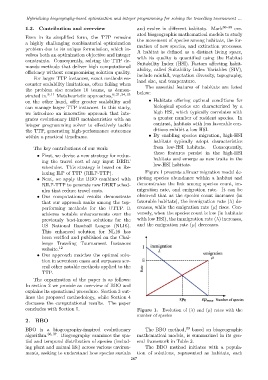
                    laxing ILP of TTP (RILP-TTP).                 Figure 1 presents a linear migration model de-
                  • Next, we apply the BBO combined with      picting species abundance within a habitat and
                    RILP-TTP to generate new DRRT sched-      demonstrates the link among species count, im-
                    ules that reduce travel costs.            migration rate, and emigration rate. It can be
                  • Our computational results demonstrate     observed that as the species count increases (in
                    that our approach ranks among the top-    favorable habitats), the immigration rate (λ) de-
                    performing methods for the UTTP. It       creases, while the emigration rate (µ) rises. Con-
                    achieves notable enhancements over the    versely, when the species count is low (in habitats
                    previously best-known solutions for the   with low HSI), the immigration rate (λ) increases,
                    US National Baseball League (NL16).       and the emigration rate (µ) decreases.
                    This enhanced solution for NL16 has
                    been verified and published on the Chal-
                    lenge Traveling Tournament Instances
                    website. 12
                  • Our approach matches the optimal solu-
                    tion in seventeen cases and surpasses sev-
                    eral other notable methods applied to the
                    TTP.
                The organization of the paper is as follows:
            In section 2 we provide an overview of BBO and
            explains its operational procedure. Section 3 out-
            lines the proposed methodology, while Section 4
            discusses the computational results. The paper
            concludes with Section 5.                         Figure 1.  Evolution of (λ) and (µ) rates with the
                                                              number of species
            2. BBO

            BBO is a biogeography-inspired evolutionary           The BBO method,   39  based on biogeographic
            algorithm. 36,37 . Biogeography examines the spa-  mathematical models, is summarized in its gen-
            tial and temporal distribution of species (includ-  eral framework in Table 3.
            ing plant and animal life) across various environ-    The BBO method initiates with a popula-
            ments, seeking to understand how species sustain  tion of solutions, represented as habitats, each
                                                           267

