Page 74 - IJOCTA-15-2
P. 74

Hybridizing biogeography-based optimization and integer programming for solving the travelling tournament ...
            Algorithm 1 Migration process:                    from team i to team j anywhere in the schedule.
                                                                            n
                                                                                          n
             1: for i=1:number habitats do                                 X             X
             2:   Select a habitat Habitat iwith probability αλ i  Minimize    d ij x ij1 +   d ij y tij
             3:   if H i is selected then                                  i,j=1        t,i,j=1
             4:     if rand ∈ (0, 1) < λ i then                                           n               (7)
             5:       Select Habitat j with probability αµ j                          +  X
             6:       if H j is selected then                                               d ji x ij,2n−2
             7:         Habitat i(SIV ) ← Habitat j(SIV )                               i,j=1
             8:       end if                                      Subject to constraints:
             9:     end if
            10:   end if
            11: end for                                       x ii = 0(i = 1, ..., 2n − 2)                (8)
                                                               n
                                                              X
                                                                 (x ijk + x jik ) = 1(i = 1, ..., n, k = 1, ...2n − 2)
                                                              j=1
                                      1 − P sp
                        Pmut(sp) = α         (4)        (5)                                               (9)
                                       P max
                                                              2n−2
            Where:                                             X
                                                                   x ijk = 1(i, j = 1, ..., n, i ̸= j)   (10)
                  • P mut (sp): Mutation rate for a habitat    k=1
                    with sp species.                           3   n
                                                              X X
                  • α: User-defined parameter.                       x ij,k+l ⩽ 3(i = 1, ..., n, k = 1, ..., 2n − 2 − 3)
                  • P sp : Probability of having sp species in  l=0 j=1
                    the habitat.                                                                         (11)
                  • P max : Probability of having the maximum  3   n
                    number of species (i.e., max P S ).       X X    x ij,k+l ⩽ 3(j = 1, ..., n, k = 1, ..., 2n − 2 − 3)
                  • P sp : Probability of the presence of sp   l=0 i=1
                    species in the habitat.                                                              (12)
                                                              x ijk + x jik + x ijk+1 + x jik+1 ≤ 1,
                     
                                 λ 0 λ 1 ...λ sp−1   ,          (i, j = 1, . . . , n, k = 1, . . . , 2n − 3)  (13)

                     
                                       n P λ λ ...λ
                                         0 1   l−1
                      µ 1 µ 2 ...µ sp 1+                            n
                     
                                           1 2
                                         µ µ ...µ l                X
                                      l=1
                                                             z iik =   x ijk (i = 1, ..., n, k = 1, ..., 2n − 2)
              P sp =       1 ≤ sp ≤ number habitats                 j=1
                               1
                     
                                       ,  sp = 0                                                        (14)
                     
                          n P λ λ ...λ
                              0 1  l−1
                       1+                                    z ijk = x ijk (i, j = 1, ..., n, i ̸= j, k = 1, .., 2n − 2)
                               µ µ ...µ l
                                1 2
                          l=1
                                                        (6)                                              (15)
                                                              y tij ⩾ z tik + z tj,k+1 − 1,
            Algorithm 2 Mutation Algorithm :                    (t, i, j = 1, . . . , n, k = 1, . . . , 2n − 3)  (16)
             1: for j = 1 to number habitats do               x ijk , z ijk , y tij ∈ {0, 1},
             2:   Use λ i and µ i to compute Pmut i
                                                                (t, i, j = 1, . . . , n, k = 1, . . . , 2n − 2)  (17)
             3:   Select Habitat i(j) with probability αPmut i
             4:   if Habitat i(j) is selected then                Where:
             5:     Replace Habitat i(j) with a random SIV         • d ij represents some distance or weight be-
             6:   end if
             7: end for                                              tween teams i and j.
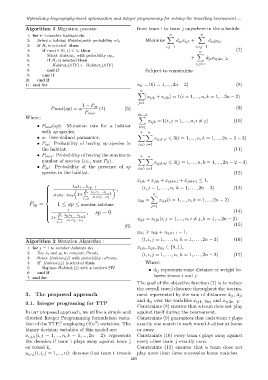
                                                              The goal of the objective function (7) is to reduce
                                                              the overall travel distance throughout the tourna-
            3. The proposed approach                          ment represented by the sum of distances d ij , d ji
                                                              and d ij over the variables x ij1 , y tij and x ij,2n−2 .
            3.1. Integer programing for TTP
                                                              Constraints (8) ensures that a team does not play
            In our proposed approach, we utilize a simple and  against itself during the tournament.
            directed Integer Programming formulation varia-   Constraints (9) guarantees that each team i plays
                            3
                                           3
            tion of the TTP, employing O(n ) variables. The   exactly one match in each round k either at home
            binary decision variables of this model are:      or away.
            x i,j,k (i, j = 1, ..., n, k = 1, ..., 2n − 2): represents  Constraints (10) every team i plays away against
            the decision if team i plays away against team j  every other team j exactly once.
            on round k,                                       Constraints (11) ensures that a team does not
            y t,i,j (t, i, j = 1, ..., n): denotes that team t travels  play more than three successive home matches.
                                                           269
   69   70   71   72   73   74   75   76   77   78   79