


Page 77 - IJOCTA-15-2
P. 77
M. Khelifa et. al. / IJOCTA, Vol.15, No.2, pp.264-280 (2025)
            less favorable habitats based on a probability of  Deviating below this value leads to a runtime ex-
            change, which is determined by the immigration    ceeding 5 hours (Figures 7 and 8). Similar consid-
            rate λ (as shown in equation 23) and the emigra-  erations apply to NL 14 and NL 16 , where the best
            tion rate µ (as shown in equation 24). Figure 3   Ft values are approximately 7 and 8, respectively,
            illustrates the migration process, with Habitat2  which corresponds to about half of the total teams
            serving as the immigrating habitat and Habitat1   (n/2).
            as the emigrating habitat:
                (1) Migrate Siv Habitat1 of Habitat 1 to the
                    Habitat 2; here the Siv Habitat1 represents  4.2. Numerical results
                    the schedule of team t 1 .
                (2) We create an incomplete schedule with     The effectiveness of the proposed method is as-
                    only the schedule of the first team.      sessed using multiple benchmark datasets for the
                    We then solve our Relaxed ILP (RILP-      TTP . The implementation was carried out using
                    TTP)(explained in Section 3.1) where      Java, with experiments performed on a system
                    Ft= t 1 to create and optimize the sched-  equipped with an Intel(R) Core(TM) i5-10210U
                                                              processor (1.60 GHz) and 8 GB of RAM.
                    ule for the remaining five teams t 2 , t 3 ,t 4
                    and t 5 . GameNonFt=represents all the        The performance of the proposed TTP BBO
                    games of Habitat2 excluding those of Ft;  approach was assessed using NL x and CON x
                    here, all the games of the first team are  instances 2,12  (refer to Section 1.1). This section
                    highlighted in red, as shown in Figure 3.  provides experimental results to analyze the effi-
                (3) In the obtained schedule, we retain the   ciency of our approach. Our approach was tested
                    home/away patterns and the location of    on various NL and CON instances (outlined in
                    GameNonFt in Habitat2, where feasible.    Section 1.1) to assess its performance on TTP
                                                              and UTTP. Tables 4 and 5 present a summary
                                                              of the results. The Best k column lists the best-
            3.2.5. The mutation process                                                         2,12
                                                              known results for each benchmark,     while the
            In each iteration of the mutation process, the    TTP BBO column reports the maximum, av-
            Variable Neighborhood Search (VNS)    41  is em-  erage and the minimum values obtained by the
            ployed as a local search heuristic to reduce the  proposed method within a 5-hour computation
            travel cost of the schedule. VNS systematically   time. The Gap  (TTP BBO/Best k )  column indicates
            changes neighborhoods within a local search, in-  the difference between the best-known results and
            volving operations such as swapping teams, swap-  the best solution obtained by our approach.
            ping home assignments, and swapping rounds.

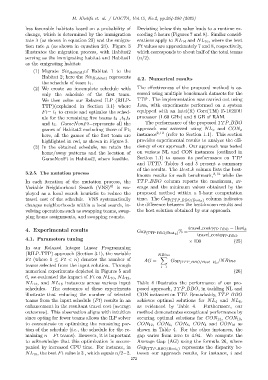
            4. Experimental results                           Gap (TTP BBO/Best k ) % =  travel cost TTP BBO − Best k
                                                                                         travel cost TTP BBO
            4.1. Parameters tuning
                                                                                     × 100               (25)
            In our Relaxed Integer Linear Programming
            (RILP-TTP) approach (Section 3.1), the variable            NBins
            Ft (where 1 ≤ Ft < n) denotes the number of          AG =   X    Gap                  /NBins
            teams selected from the input solution. Through             i=1      (TTP BBO/Best−k) i
            numerical experiments depicted in Figures 5 and                                              (26)
            6, we evaluated the impact of Ft on NL 10 , NL 12 ,
            NL 14 , and NL 16 instances across various input  Table 4 illustrates the performance of our pro-
            schedules. The outcomes of these experiments      posed approach, TTP BBO, in tackling NL and
            illustrate that reducing the number of selected   CON instances on TTP. Remarkably, TTP BBO
            teams from the input schedule (Ft) results in an  achieves optimal solutions for NL 4 and NL 6 ,
            enhancement in the resultant travel cost (average  as evidenced by Table 4.    Furthermore, our
            outcomes). This observation aligns with intuition  method demonstrates exceptional performance by
            since opting for fewer teams allows the ILP solver  securing optimal solutions for CON 14 , CON 10 ,
            to concentrate on optimizing the remaining por-   CON 12 , CON 6 , CON 8 , CON 4 and CON 16 as
            tion of the schedule (i.e., the schedule for the re-  shown in Table 4. For the other instances, the
            maining n − Ft teams). However, it is important   gap varies from zero to 4.94. We compute the
            to acknowledge that this optimization is accom-   Average Gap (AG) using the formula 26, where
            panied by increased CPU time. For instance, in    Gap (TTP BBO/Best k )  represents the disparity be-
            NL 10 , the best Ft value is 3 , which equals n/2−2.  tween our approach results, for instance, i and
                                                           272

