


Page 73 - IJOCTA-15-2
P. 73
M. Khelifa et. al. / IJOCTA, Vol.15, No.2, pp.264-280 (2025)
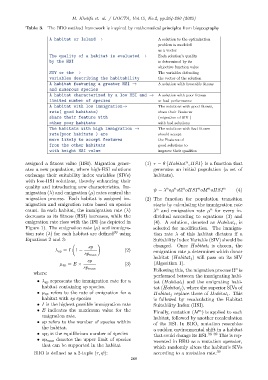
            Table 3. The BBO method framework is inspired by mathematical principles from biogeography

                       A habitat or Island →                           A solution to the optimization
                                                                       problem is modeled
                                                                       as a vector
                       The quality of a habitat is evaluated →         Each solution’s quality
                       by the HSI                                      is determined by its
                                                                       objective function value
                       SIV or the →                                    The variables defending
                       variables describing the habitability           the vector of the solution
                       A habitat featuring a greater HSI →             A solution with favorable fitness
                       and numerous species
                       A habitat characterized by a low HSI and →      A solution with poor fitness
                       limited number of species                       or bad performance
                       A habitat with low immigration→                 The solutions with good fitness,
                       rate( good habitats)                            share their Features
                       share their feature with                        (migration of SIV )
                       other poor habitats                             with bad solutions
                       The habitats with high immigration →            The solutions with bad fitness
                       rate(poor habitats ) are                        should accept
                       more likely to accept features                  the Features of
                       from the other habitats                         good solutions to
                       with height HSI value                           improve their qualities

                                                                                    n
            assigned a fitness value (HSI). Migration gener-     (1) τ = θ {Habitat , HSI} is a function that
            ates a new population, where high-HSI solutions          generates an initial population (a set of
            exchange their suitability index variables (SIVs)        habitats).
            with low-HSI solutions, thereby enhancing their
            quality and introducing new characteristics. Im-               n  n   n      n    n     n
                                                                     ψ = λ oµ oΩ oHSI oM oHSI             (4)
            migration (λ) and emigration (µ) rates control the
            migration process. Each habitat is assigned im-      (2) The function for population transition
            migration and emigration rates based on species          starts by calculating the immigration rate
                                                                      n
                                                                                              n
            count. In each habitat, the immigration rate (λ)         λ and emigration rate µ for every in-
            decreases as its fitness (HSI) increases, while the      dividual according to equations (3) and
            emigration rate rises with the HSI (as depicted in       (4). A solution, denoted as Habitat i , is
            Figure 1). The emigration rate (µ) and immigra-          selected for modification. The immigra-
            tion rate (λ) for each habitat are defined 39  using     tion rate λ of this habitat dictates if a
            Equations 2 and 3:                                       Suitability Index Variable (SIV) should be

                                        sp                           changed. Once Habitat i is chosen, the
                          λ sp = I 1 −                  (2)          emigration rate µ determines which donor
                                       sp max
                                                                     habitat (Habitat j ) will pass on its SIV
                                        sp
                            µ sp = E ×                  (3)          (Algorithm 1).
                                      sp max                                                              n
                                                                     Following this, the migration process Ω is
                where:
                                                                     performed between the immigrating habi-
                  • λ sp represents the immigration rate for a       tat (Habitat i ) and the emigrating habi-
                    habitat containing sp species.                   tat (Habitat j ), where the superior SIVs of
                  • µ sp refers to the rate of emigration for a      Habitat j replace those of Habitat i . This
                    habitat with sp species                          is followed by recalculating the Habitat
                  • I is the highest possible immigration rate       Suitability Index (HSI).
                  • E indicates the maximum value for the                                 n
                                                                     Finally, mutation (M ) is applied to each
                    emigration rate.
                                                                     habitat, followed by another recalculation
                  • sp refers to the number of species within
                                                                     of the HSI. In BBO, mutation resembles
                    the habitat.
                                                                     a sudden environmental shift in a habitat
                  • sp 0 is the equilibrium number of species                                36–39
                                                                     that could change its HSI.   This is rep-
                  • sp max denotes the upper limit of species
                                                                     resented in BBO as a mutation operator,
                    that can be supported in the habitat
                                                                     which randomly alters the habitat’s SIVs
                BBO is defined as a 2-tuple (τ, ψ):                  according to a mutation rate. 39
                                                           268

