


Page 30 - IJOCTA-15-3
P. 30
S.Ezzeroual, B.Sadik / IJOCTA, Vol.15, No.3, pp.396-406 (2025)
Thus This motion can be represented in matrix form as
∂f 3 follows:
= c 1 cosh z + f(x, y),
∂x
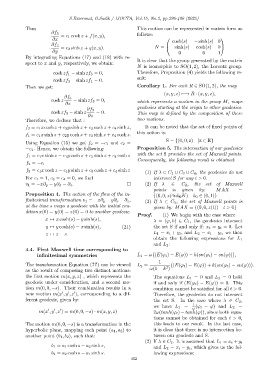
cosh(s) − sinh(s) 0
∂f 3
= c 2 sinh z + g(x, y). N = − sinh(s) cosh(s) 0
∂y 0 0 1
By integrating Equations (17) and (18) with re-
It is clear that the group generated by the matrix
spect to x and y, respectively, we obtain:
N is isomorphic to SO(1, 2), the Lorentz group.
cosh zf 1 − sinh zf 3 = 0, Therefore, Proposition (4) yields the following re-
sult:
cosh zf 3 − sinh zf 1 = 0.
Then we get: Corollary 1. For each R ∈ SO(1, 2), the map
(x, y, z) 7−→ R · (x, y, z),
∂f 3
cosh z − sinh zf 3 = 0, which represents a motion in the group M, maps
∂z
geodesics starting at the origin to other geodesics.
∂f 3
cosh zf 3 − sinh z = 0. This map is defined by the composition of these
∂z
Therefore, we deduce that : two motions.
f 3 = c 1 x cosh z + c 2 y sinh z + c 3 cosh z + c 4 sinh z, It can be noted that the set of fixed points of
this action is:
f 1 = c 1 x sinh z + c 2 y cosh z + c 3 sinh z + c 4 cosh z.
S = {(0, 0, z) |z ∈ R}
Using Equation (15) we get f 2 = −c 1 and c 2 =
−c 1 . Hence, we obtain the following: Proposition 5. The intersection of our geodesics
f 1 = c 1 x sinh z − c 1 y cosh z + c 3 sinh z + c 4 cosh z with the set S provides the set of Maxwell points.
Consequently, the following result is obtained:
f 2 = −c 1
f 3 = c 1 x cosh z − c 1 y sinh z + c 3 cosh z + c 4 sinh z
(1) If λ ∈ C 1 ∪ C 3 ∪ C 4 , the geodesics do not
For c 1 = 1, c 3 = c 4 = 0, we find intersect S for any t > 0.
v 1 = −x∂ y − y∂ x − ∂ z . □ (2) If λ ∈ C 2 , the set of Maxwell
points is given by: MAX =
Proposition 4. The action of the flow of the in- {(0, 0, z(4nk 0 K) k 0 ∈ (0, 1)}
finitesimal transformation v 1 = −x∂ y − y∂ x − ∂ z , (3) If λ ∈ C 5 , the set of Maxwell points is
at the time s maps a geodesic with the initial con- given by: MAX = {(0, 0, z(t)) t > 0}
dition x(0) = y(0) = z(0) = 0 to another geodesic.
Proof. (1) We begin with the case where
x 7→ x cosh(s) − y sinh(s), λ = (φ, k) ∈ C 1 , the geodesics intersect
y 7→ y cosh(s) − x sinh(s), (21) the set S if and only if: x t = y t = 0. Let
z 7→ z − s. L 1 = x t + y t , and L 2 = x t − y t , we then
obtain the following expressions for L 1
and L 2 :
4.4. First Maxwell time corresponding to
infinitesimal symmetries L 1 = ω (E(φ t ) − E(φ)) − k(sn(φ t ) − sn(φ)) ,
1
The transformation Equation (??) can be viewed L 2 = 2 (E(φ t ) − E(φ)) + k(sn(φ t ) − sn(φ)) .
as the result of composing two distinct motions: ω(1 − k )
the first motion m(x, y, z) , which represents the The equations L 1 = 0 and L 2 = 0 hold
geodesic under consideration, and a second mo- if and anly if (E(φ t ) − E(φ)) = 0. This
tion m(0, 0, −s). Their combination results in a condition cannot be satisfied for all t > 0.
′
′
′
new motion m(x , y , z ), corresponding to a dif- Therefore, the geodesics do not intersect
ferent geodesic, given by: the set S. In the case where λ ∈ C 3 ,
1
we have L 1 = ω (φ t − φ) and L 2 =
′
′
′
m(x , y , z ) = m(0, 0, −s) · m(x, y, z) 2ω(tanh(φ t ) − tanh(φ)), since both equa-
tions cannot be obtained for each t > 0,
The motion m(0, 0, −s) is a transformation in the this leads to our result. In the last case,
hyperbolic plane, mapping each point (a 1 , a 2 ) to it is clear that there is no intersection be-
another point (b 1 , b 2 ), such that: tween our geodesic and S.
(2) If λ ∈ C 2 . It is assumed that L 1 = x t + y t
b 1 = a 1 cosh s − a 2 sinh s, and L 2 = x t − y t , which gives us the fol-
b 2 = a 2 cosh s − a 1 sinh s. lowing expressions:
402

