


Page 31 - IJOCTA-15-3
P. 31
Using infinitesimal symmetries for determining the first Maxwell time of geometric control problem on SH(2)


                                            ′2
               L 1 = ω − (E(ψ t ) − E(ψ)) + k (ψ t − ψ)


                 +k sn(ψ t ) − sn(ψ)  ,

                                               ′2
               L 2 =   1    (E(ψ t ) − E(ψ)) − k (ψ t − ψ)
                         2
                     ω(1−k )


                 +k sn(ψ t ) − sn(ψ)  .
                    We have L 1 = 0 and L 2 = 0. if and
                    only if both equations,

                    h 1 = 2k( sn(ψ t ) − sn(ψ) = 0 and
                                            ′2
                    h 2 = (E(ψ t ) − E(ψ)) − k (ψ t − ψ) = 0,
                    hold. The equation h 1 = 0 holds exclu-
                    sively when t = 4nkK with k ∈ (0, 1).
                    Here
                            R  π/2   dt
                                                          2
                    K(k) =       √         ,  k ′2  = 1 − k ,
                             0     1−k sin t
                                         2
                                      2
                    for these given values, it follows that
                                                 ′2
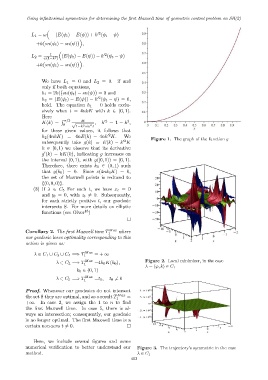
                    h 2 (4nkK) = 4nE(k) − 4nk K.        We          Figure 1. The graph of the function g
                                                        ′2
                    subsequently take g(k) = E(k) − k K
                    k ∈ [0, 1) we observe that its derivative
                     ′
                    g (k) = kK(k), indicating g increases on
                    the interval [0, 1), with g([0, 1)) = [0, 1).
                    Therefore, there exists k 0 ∈ (0, 1) such
                    that g(k 0 ) = 0. Since z(4nk 0 K) = 0,
                    the set of Maxwell points is reduced to
                    {(0, 0, 0)}.
                (3) If λ ∈ C 5 For each t, we have x t = 0
                    and y t = 0, with z t ̸= 0. Subsequently,
                    for each strictly positive t, our geodesic
                    intersects S. For more details on elliptic
                                       18
                    functions (see Olver )
                                                         □


            Corollary 2. The first Maxwell time T  Max  where
                                                 1
            our geodesic loses optimality corresponding to this
            action is given as:

                λ ∈ C 1 ∪ C 3 ∪ C 4 =⇒ T 1 Max  = + ∞
                          λ ∈ C 2 =⇒ T 1 Max  =4k 0 K(k 0 ),      Figure 2. Local minimizer, in the case
                                                                  λ = (φ, k) ∈ C 1
                                   k 0 ∈ (0, 1)
                          λ ∈ C 5 =⇒ T 1 Max  =t 0 ,  t 0 ̸= 0


            Proof. Whenever our geodesics do not intersect
            the set S they are optimal, and as a result T Max  =
                                                     1
            +∞. In case 2, we assign the 1 to n to find
            the first Maxwell time. In case 5, there is al-
            ways an intersection; consequently, our geodesic
            is no longer optimal. The first Maxwell time is a
            certain non-zero t ̸= 0.                     □


                Here, we include several figures and some
            numerical verification to better understand our   Figure 3. The trajectory’s symmetric in the case
            method.                                           λ ∈ C 1
                                                           403

