


Page 40 - IJOCTA-15-3
P. 40
M. Aychluh et.al. / IJOCTA, Vol.15, No.3, pp.407-425 (2025)
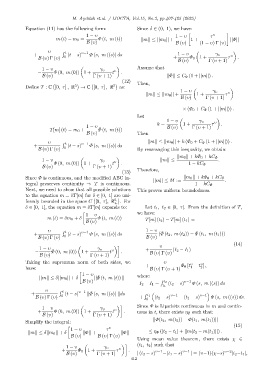
            Equation (11) has the following form:             Since δ ∈ (0, 1), we have:
                                       1 − υ                                   1 − υ         τ υ
                          m (t) − m 0 =      Φ (t, m (t))       ||m|| ≤ ||m 0 || +    1 +              ||Φ||
                                       B (υ)                                   B (υ)      (1 − υ) Γ (υ)

                      υ     R  t     υ−1
                +              (t − s)   Φ (s, m ((s)) ds                       1 − υ            γ υ   υ
                  B (υ) Γ (υ)  0                                              +      Φ 0 1 +          τ    .
                                                                                B (υ)         Γ (υ + 1)
                                                            Assume that
                    1 − υ                    γ υ
                  −      Φ (0, m (0)) 1 +          t υ  .
                    B (υ)                 Γ (υ + 1)                        ||Φ|| ≤ C Φ (1 + ||m||) .
                                                       (12)
                                  5               5         Then,
            Define T : C [0, τ] , R  → C [0, τ] , R   as:
                                                                                 1 − υ         γ υ
                                                                  ||m|| ≤ ||m 0 || +    1 +          τ υ
                                                                                 B (υ)      Γ (υ + 1)

                                                                                  × (Φ 0 + C Φ (1 + ||m||)) .
                                                              Let

                                                                           1 − υ         γ υ    υ
                                                                       k =        1 +          τ   .
                                       1 − υ                               B (υ)      Γ (υ + 1)
                       T[m] (t) = m 0 +      Φ (t, m (t))
                                       B (υ)                  Then
                      υ     R  t     υ−1                           ||m|| ≤ ||m 0 || + k (Φ 0 + C Φ (1 + ||m||)) .
                +              (t − s)   Φ (s, m ((s)) ds
                  B (υ) Γ (υ)  0                              By rearranging this inequality, we obtain:
                                                                                ||m 0 || + kΦ 0 + kC Φ

                    1 − υ                    γ υ                        ||m|| ≤                   .
                  −      Φ (0, m (0)) 1 +          t υ  .                            1 − kC Φ
                    B (υ)                 Γ (υ + 1)
                                                              Therefore,
                                                       (13)
            Since Φ is continuous, and the modified ABC in-                       ||m 0 || + kΦ 0 + kC Φ
                                                                     ||m|| ≤ M :=                    .
            tegral preserves continuity ⇒ T is continuous.                              1 − kC Φ
            Next, we need to show that all possible solutions  This proves uniform boundedness.
            to the equation m = δT[m] for δ ∈ [0, 1] are uni-
                                                    5
            formly bounded in the space C [0, τ], R +  . For
            δ ∈ [0, 1], the equation m = δT[m] expands to:        Let t 1 , t 2 ∈ [0, τ]. From the definition of T,
                                                             we have:
                                       1 − υ
                      m (t) = δm 0 + δ      Φ (t, m (t))          T[m] (t 2 ) − T[m] (t 1 ) =
                                       B (υ)
                      υ     R  t     υ−1                          1 − υ
                +            0  (t − s)  Φ (s, m ((s)) ds              (Φ (t 2 , m (t 2 )) − Φ (t 1 , m (t 1 )))
                  B (υ) Γ (υ)                                     B (υ)
                                                                                                         (14)
                                                                     υ
                   1 − υ                    γ υ                   +           (I 2 − I 1 )
                 −      Φ (0, m (0)) 1 +          t υ  .            B (υ) Γ (υ)
                   B (υ)                 Γ (υ + 1)
            Taking the supremum norm of both sides, we                    υ           υ   υ
                                                                  +              Φ 0 [t − t ] ,
            have:                                                   B (υ) Γ (υ + 1)   1   2

                                      1 − υ
                  ||m|| ≤ δ||m 0 || + δ    ||Φ (t, m (t)) ||  where
                                      B (υ)                             R  t 2     υ−1
                                                               I 2 − I 1 =  (t 2 − s)  Φ (s, m ((s)) ds
                                                                         t 1
                     υ     R  t     υ−1
               +              (t − s)   ||Φ (s, m ((s)) ||ds     R  t 1     υ−1          υ−1
                 B (υ) Γ (υ)  0                                +      (t 2 − s)  − (t 1 − s)   Φ (s, m ((s)) ds.
                                                                  0
                                                           Since Φ is Lipschitz continuous in m and contin-
                    1 − υ                    γ υ
                  +      Φ (0, m (0)) 1 +          t υ  .     uous in t, there exists η Φ such that:
                    B (υ)                 Γ (υ + 1)
                                                                     ||Φ(t 2 , m(t 2 )) − Φ(t 1 , m(t 1 ))||
            Simplify the integral:
                                                                                                         (15)
                                                υ
                                1 − υ           τ
             ||m|| ≤ δ||m 0 || + δ    ||Φ|| +          ||Φ||       ≤ η Φ (|t 2 − t 1 | + ||m(t 2 − m(t 1 )||) .
                                B (υ)       B (υ) Γ (υ)
                                                              Using mean value theorem, there exists χ ∈
                                                           (t 1 , t 2 ) such that
                              1 − υ            γ υ
                            +       Φ 0 1 +          τ υ  .           υ−1         υ−1                υ−2
                              B (υ)         Γ (υ + 1)         | (t 2 − s)  −(t 1 − s)  | = (υ−1)(χ−s)   |t 2 −t 1 |,
                                                           412

