


Page 37 - IJOCTA-15-3
P. 37
Modeling and analysis of the dynamics of an excessive gambling problem with modified fractional operator
integer order derivatives. Recent studies its non-singular kernel and ability to model mem-
have confirmed the effectiveness of the mod- ory effects, providing a more realistic representa-
ified Atangana-Baleanu-Caputo (mABC) frac- tion of gambling addiction. The modified ABC
tional derivative in solving linear and nonlin- fractional derivative operator is an acceptable op-
ear problems, such as the linear time-fractional tion because of its ability to represent the dy-
advection-diffusion equation, 27 the spread of the namical systems effectively. Traditional models
polio model including the vaccination effect, 28 fail to capture memory effects and realistic tran-
the hepatitis C model, 29 novel solutions of frac- sition dynamics. The modified ABC operator
tional differential equations, 30 the fractional- demonstrates superior performance in represent-
order leukemia model 31 and the waterborne dis- ing real-world problems. The study makes impor-
ease model. 32 tant contributions to the ongoing advancement of
This study focuses on fractional model- dynamical systems, particularly in gambling ad-
ing of the problem of excessive gambling us- diction.
ing the mABC non-integer order derivative op- The remainder of this paper is organized as
erator, which is a modified version of the follows. A definition of mABC fractional deriva-
Atangana-Baleanu-Caputo fractional derivative tive and some of its basic properties are provided
operator. in Section 2. The fractional model for the prob-
Systems of fractional differential equations are lem of excessive gambling and its qualitative anal-
used to represent many real-life issues. Non- ysis are discussed in Section 3. The numerical
linear problems can be successfully modeled us- scheme for approximating the proposed system is
ing a system of arbitrary-order differential equa- presented in Section 4. In Section 5, we discuss
tions. However, finding analytical results for sys- the results of numerical simulations. Finally, con-
tems of ordinary differential equations involving clusion is presented.
nonlinear terms can be highly difficult, requiring
approximation techniques to find numerical val- 2. Fundamental concepts
ues.
Numerous numerical schemes have been This section provides the most important def-
created to obtain approximate results of initions and properties applied throughout the
non-integer order differential equations. study. It presents a clear overview of the modified
Some of these methods include the frac- ABC fractional calculus in the Caputo sense.
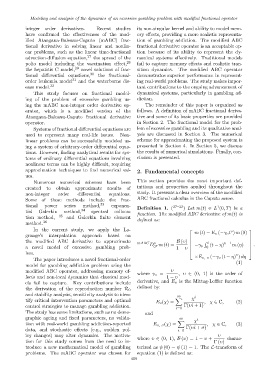
tional power series method, 33 exponen- Definition 1. ( 27–32 ) Let m(t) ∈ L (0, T) be a
1
tial Galerkin method, 34 spectral colloca- function. The modified ABC derivative of m(t) is
tion method, 35 and Galerkin finite element defined as:
method. 36
In the current study, we apply the La- υ
m (t) − E υ (−γ υ t ) m (0)
grange’s interpolation approach based on
the modified ABC derivative to approximate mABC υ B (υ) R t υ−1
a novel model of excessive gambling prob- D +m (t) = 1 − υ −γ υ 0 (t − η) m (η) .
0
lem. υ
×E υ, υ (−γ υ (t − η) ) dη
The paper introduces a novel fractional-order
model for gambling addiction problem using the (1)
modified ABC operator, addressing memory ef- υ
where γ υ = , υ ∈ (0, 1) is the order of
fects and non-local dynamics that classical mod- 1 − υ
els fail to capture. Key contributions include derivative, and E υ is the Mittag-Leffler function
defined by:
the derivation of the reproduction number R 0
and stability analysis, sensitivity analysis to iden- ∞ i
tify critical intervention parameters and optimal E υ (χ) = X χ , χ ∈ C, (2)
control strategies to manage gambling addiction. i=0 Γ(υi + 1)
The study has some limitations, such as no demo- and
graphic ageing and fixed parameters, no valida- ∞ i
X χ
tion with real-world gambling addiction-reported E υ, σ (χ) = , χ ∈ C, (3)
data, and stochastic effects (e.g., sudden pol- i=0 Γ(υi + σ)
icy changes) may alter dynamics. The motiva- υ
where υ ∈ (0, 1), B (υ) = 1 − υ + charac-
tion for this study comes from the need to in- Γ (υ)
troduce a new mathematical model of gambling terized as ψ (0) = ψ (1) = 1. The L-transform of
problems. The mABC operator was chosen for equation (1) is defined as:
409

