


Page 38 - IJOCTA-15-3
P. 38
M. Aychluh et.al. / IJOCTA, Vol.15, No.3, pp.407-425 (2025)
                                                              using a parameter α 1 , which is directly related to

                                            υ
                                 L  mABC  D m (t) (η)         the proportion of non-problem gamblers, minor
                                           0
                                    0
                                                              risk gamblers, and excessive problem gamblers al-
                                                        (4)
                         υ                υ−1
                  B (υ) η L {m (t)} (η) − η   m (0)           ready participating in gambling activities.
               =                                     .
                                    υ
                  1 − υ           η + γ υ
                                                                          ϑ 1  =  γ 1 A + γ 2 M + γ 3 P  .
                                               1
            Definition 2. ( 27–32 ) Let m (t) ∈ L (0, T) be a             α 1          T
            function. The modified ABC integral is then ex-   Individuals in stage A may transfer to stage R
            press as follows:                                 by stopping any gambling activities before ad-
                              ψ (1 − υ)                       diction, measured using a parameter ℘, or they
                mAB υ                  [m (t) − m (0)]
                    I m (t) =
                     0
                                B (υ)                         may develop minor symptoms of problem gam-
                                                        (5)
                                                              bling. This step could be induced by the influ-

                                RL υ                          ence rate, measured in terms of the proportion
                           +γ υ   I (m (t) − m (0)) .
                                   0
                                                              of already existing problematic gambling stages:
            where, the Riemann-Liouville integral operator is  γ 2 M + γ 3 P
            given by                                                      multiplied by a proportionality pa-
                                                                   T
                                                              rameter α 2 . Therefore, the overall problem gam-
                                     Z  t
                                 1         s (η)              bling rate is:
                   RL υ
                     I m (t) =                    dη.   (6)
                               Γ (υ)  0 (t − η) 1−υ
                                                                             ϑ 2  γ 2 M + γ 3 P
                                                                                =             .
            3. Model formulation                                             α 2       T
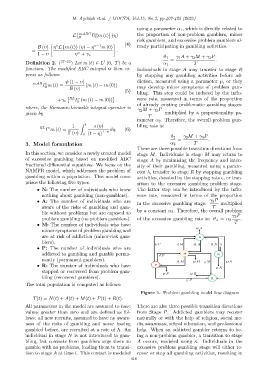
                                                              There are three possible transition directions from
            In this section, we consider a newly created model  stage M. Individuals in stage M may return to
            of excessive gambling based on modified ABC       stage A by minimizing the frequency and inten-
            fractional differential equations. We focus on the  sity of their gambling, measured using a param-
            NAMPR model, which addresses the problem of       eter λ, transfer to stage R by stopping gambling
            gambling within a population. This model com-     activities, denoted by the stopping rate ς, or tran-
            prises the following five types.                  sition to the excessive gambling problem stage.
                  • N: The number of individuals who know     The latter step can be introduced by the influ-
                    nothing about gambling (non-gamblers).    ence rate, measured in terms of the proportion
                  • A: The number of individuals who are                                      γ 3 P
                                                              in the excessive gambling stage:     multiplied
                    aware of the risks of gambling and gam-                                    T
                    ble without problems but are exposed to   by a constant α 3 . Therefore, the overall problem
                                                                                                        γ 3 P
                    problem gambling (no problem gamblers).   of the excessive gambling rate is: ϑ 3 = α 3  .
                                                                                                         T
                  • M: The number of individuals who have
                    minor symptoms of problem gambling and
                    are at risk of addiction (minor-risk gam-
                    blers).
                  • P: The number of individuals who are
                    addicted to gambling and gamble perma-
                    nently (permanent gamblers).
                  • R: The number of individuals who have
                    stopped or recovered from problem gam-
                    bling (recovered gamblers).
            The total population is computed as follows:
                                                               Figure 1. Problem gambling model flow diagram
                T(t) = N(t) + A(t) + M(t) + P(t) + R(t).
            All parameters in the model are assumed to have   There are also three possible transition directions
            values greater than zero and are defined as fol-  from Stage P. Addicted gamblers may recover
            lows: all new recruits, assumed to have no aware-  naturally or with the help of religion, social me-
            ness of the risks of gambling and never having    dia awareness, school education, and professional
            gambled before, are recruited at a rate of Λ. An  help. When an addicted gambler returns to be-
            individual in stage N is not introduced to gam-   ing a non-problem gambler, a transition to stage
            bling, but contacts from gamblers urge them to    A occurs, modeled using κ. Individuals in the
            gamble with no problems, leading them to transi-  excessive problem gambling stage will either re-
            tion to stage A at time t. This contact is modeled  cover or stop all gambling activities, resulting in
                                                           410

