Page 39 - IJOCTA-15-3
P. 39

Modeling and analysis of the dynamics of an excessive gambling problem with modified fractional operator
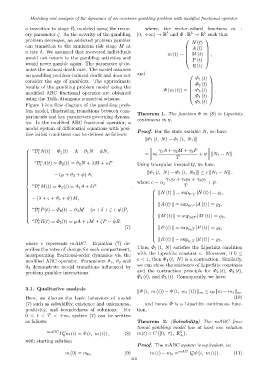
            a transition to stage R, modeled using the recov-     where, the vector-valued functions m      :
                                                                           5
                                                                                            5
                                                                                      5
            ery parameter ζ. As the severity of the gambling  [0, +∞) → R and Φ : R → R such that
            problem decreases, an addicted problem gambler                                 
                                                                                      N (t)
            can transition to the minimum risk stage M at
                                                                                     A (t)  
            a rate δ. We assumed that recovered individuals                                
                                                                            m (t) =    M (t)    ,
            would not return to the gambling activities and                                
                                                                                      P (t)
                                                                                           
            would never gamble again. The parameter ψ de-
                                                                                      R (t)
            notes the natural death rate. The model assumes
                                                              and
            no gambling problem-induced death and does not                                   
                                                                                        Φ 1 (t)
            consider the age of gamblers. The approximate
                                                                                       Φ 2 (t)  
            results of the gambling problem model using the                                  
                                                                          Φ (m (t)) =    Φ 3 (t)    .
            modified ABC fractional operator are obtained                                    
                                                                                       Φ 4 (t)  
            using the Tofik-Atangana numerical scheme.
                                                                                        Φ 5 (t)
            Figure 1 is a flow diagram of the gambling prob-
            lem model, illustrating transitions between com-
                                                              Theorem 1. The function Φ in (8) is Lipschitz
            partments and key parameters governing dynam-
                                                              continuous in η.
            ics. In the modified ABC fractional operator, a
            model system of differential equations with posi-
            tive initial conditions can be defined as follows:  Proof. For the state variable N, we have
                                                                 ∥Φ 1 (t, N) − Φ 1 (t, N 1 )∥
                D N(t) = Φ 1 (t) = Λ − ϑ 1 N − ψN,
              ∗  υ                                                 
   γ 1 A + γ 2 M + γ 3 P
                 t                                              = α 1                   + ψ ∥N 1 − N∥ .


            
                                                                   
          T
            
            
               ∗  υ
                D A(t) = Φ 2 (t) = ϑ 1 N + λM + κP
                  t                                          Using triangular inequality, we have
            
            
            
            
                                                                 ∥Φ 1 (t, N) − Φ 1 (t, N 1 )∥ ≤ c ∥N 1 − N∥ .
                         − (℘ + ϑ 2 + ψ) A,
            
            
            
            
                                                                           γ 1 ϱ 2 + γ 2 ϱ 3 + γ 3 ϱ 3
            
            
                                                             where c = α 1                  + ψ.
               ∗ D M(t) = Φ 3 (t) = ϑ 2 A + δP             .                       T
                  υ
                  t
                                                                    
            
                                                                    ∥N (t) ∥ = sup    |N (t) | = ϱ 1 ,
                                                                                    t∈T
                                                                   
             − (λ + ς + ϑ 3 + ψ) M,                                
            
            
                                                                    
                                                                    
                                                                   
                                                                   
                                                                    ∥A (t) ∥ = sup    |A (t) | = ϱ 2 ,
                                                                    
                                                                                    t∈T
             ∗   υ                                                 
            
             D P(t) = Φ 4 (t) = ϑ 3 M − (κ + δ + ζ + ψ)P,          
                                                                    
            
                  t
                                                                   
            
                                                                      ∥M (t) ∥ = sup    |M (t) | = ϱ 3 ,
                                                                                    t∈T
                  υ
               ∗ D R(t) = Φ 5 (t) = ℘A + ςM + ζP − ψR.              
            
                  t
                                                                    
                                                                    
                                                                    
                                                        (7)          ∥P (t) ∥ = sup t∈T  |P (t) | = ϱ 4 ,
                                                                    
                                                                    
                                                                    
                                                                    
                                                                    
                                                                    
                                                                    
                                                                       ∥R (t) ∥ = sup t∈T  |R (t) | = ϱ 5 .
                                                                    
            where ∗ represents mABC.      Equation (7) de-
                                                              Thus, Φ 1 (t, N) satisfies the Lipschitz condition
            scribes the rates of change for each compartment,
            incorporating fractional-order dynamics via the   with the Lipschitz constant c. Moreover, if 0 ≤
                                                              c < 1, then Φ 1 (t, N) is a contraction. Similarly,
            modified ABC operator. Parameters ϑ 1 , ϑ 2 and
                                                              we can show the existence of Lipschitz constants
            ϑ 3 demonstrate model transitions influenced by
                                                              and the contraction principle for Φ 2 (t), Φ 3 (t),
            problem gambler interactions.
                                                              Φ 4 (t), and Φ 5 (t). Consequently, we have:
            3.1. Qualitative analysis
                                                              ∥Φ (t, m (t)) − Φ (t, m 1 (t)) ∥ ∞ ≤ η Φ ∥m − m 1 ∥ ∞ .
            Here, we discuss the basic behaviors of model                                                (10)
            (7) such as solvability, existence and uniqueness,    and hence Φ is a Lipschitz continuous func-
            positivity, and boundedness of solutions.   For   tion.
            0 < t < T < +∞, system (7) can be written
            as follows:                                       Theorem 2. (Solvability) The mABC frac-
                                                              tional gambling model has at least one solution
                      mABC   υ                                                   5
                           D m (t) = Φ (t, m (t)) ,     (8)   m(t) ∈ C [0, τ] , R +  .
                             0
            with starting solution
                                                              Proof. The mABC system is equivalent to:
                                                                                      υ
                              m (0) = m 0 ,             (9)         m (t) − m 0 = mAB  I Φ (t, m (t)) .  (11)
                                                                                      0
                                                           411
   34   35   36   37   38   39   40   41   42   43   44