


Page 44 - IJOCTA-15-3
P. 44
M. Aychluh et.al. / IJOCTA, Vol.15, No.3, pp.407-425 (2025)
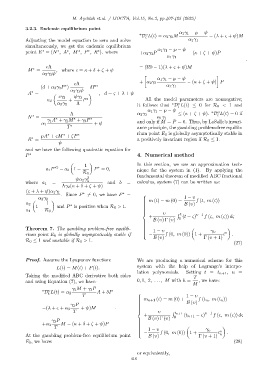
3.2.3. Endemic equilibrium point
α 1 γ 1 − ℘ − ψ
υ
∗ D L(t) = α 2 γ 2 M − (λ + ς + ψ)M
t
Adjusting the model equation to zero and solve α 1 γ 1
simultaneously, we get the endemic equilibrium
∗
∗
∗
∗
∗
∗
point E = (N , A , M , P , R ). where +α 2 γ 3 P α 1 γ 1 − ℘ − ψ − (κ + ζ + ψ)P
α 1 γ 1
.
cΛ = (ℜ0 − 1)(λ + ς + ψ)M
∗
M = , where c = κ + δ + ζ + ψ
α 3 γ 3 ψ
α 1 γ 1 − ℘ − ψ
cΛ + α 2 γ 3 − (κ + ζ + ψ) P
∗
(d + α 3 γ 3 P ) − δP ∗ α 1 γ 1
∗
A = α 3 γ 3 ψ , d = ς + λ + ψ
cγ 2 ψγ 3 ∗
α 2 + P All the model parameters are nonnegative;
∗
υ
α 3 γ 3 Λ it follows that D L(t) ≤ 0 for R 0 < 1 and
t
α 1 γ 1 − ℘ − ψ
υ
∗
Λ α 2 γ 3 ≤ (κ + ζ + ψ). D L(t) = 0 if
t
∗
N = ∗ ∗ ∗ α 1 γ 1
γ 1 A + γ 2 M + γ 3 P and only if M = P = 0. Thus, by LaSalle’s invari-
α 1 + ψ
T ∗ ance principle, the gambling problem-free equilib-
∗
∗
℘A + ςM + ζP ∗ rium point E 0 is globally asymptotically stable in
∗
R = a positively invariant region if R 0 ≤ 1.
ψ
and we have the following quadratic equation for
P ∗ 4. Numerical method
1 In this section, we use an approximation tech-
∗
a 1 P ∗2 − a 2 1 − P = 0, nique for the system in (1). By applying the
R 0
fundamental theorem of modified ABC fractional
ψα 2 γ 3 2
where a 1 = and b = calculus, system (7) can be written as:
Λγ 2 (κ + δ + ζ + ψ)
(ς + λ + ψ)α 1 γ 1 ∗ ∗
. Since P ̸= 0, we have P =
1 − υ
m (t) − m (0) =
α 2 γ 2
f (t, m (t))
a 2 1 B (υ)
∗
1 − and P is positive when R 0 > 1.
a 1 R 0
υ R t υ−1
+ 0 (t − ς) f (ς, m (ς)) dς
B (υ) Γ (υ)
Theorem 7. The gambling problem-free equilib-
1 − υ γ υ υ
rium point E 0 is globally asymptotically stable if − f (0, m (0)) 1 + t .
B (υ) Γ (υ + 1)
R 0 ≤ 1 and unstable if R 0 > 1.
(27)
Proof. Assume the Lyapunov function: We are producing a numerical scheme for this
L(t) = M(t) + P(t). system with the help of Lagrange’s interpo-
lation polynomials. Setting t = t n+1 , n =
Taking the modified ABC derivative both sides T
and using Equation (7), we have: 0, 1, 2, . . . , M with h = , we have:
M
γ 2 M + γ 3 P
∗ υ
D L(t) = α 2 A + δP
t
T 1 − υ
m n+1 (t) = m (0) + f (t n , m (t n ))
B (υ)
γ 3 P
−(λ + ς + α 3 + ψ)M .
T υ R υ−1
+ 0 t n+1 (t n+1 − ς) f (ς, m (ς)) dς
γ 3 P B (υ) Γ (υ)
+α 3 M − (κ + δ + ζ + ψ)P
T
1 − υ γ υ υ
− f (0, m (0)) 1 + t n .
At the gambling problem-free equilibrium point B (υ) Γ (υ + 1)
E 0 , we have: (28)
or equivalently,
416

