


Page 59 - IJOCTA-15-3
P. 59
Predefined-time fractional-order terminal SMC for robot dynamics
                                                              in increased responsiveness, lower tracking er-
                                                              ror, and greater control over nonlinear dynamics.
                                                              This work thoroughly addresses the constraints of
                                                              the proposed controller parameters and stability
                                                              proofs. The FoPtSMC approach’s proper param-
                                                              eters were carefully determined within designated
                                                              ranges to obtain the overall system’s stability and
                                                              error convergence within a fixed time. The study
                                                              underlines the need to select appropriate param-
                                                              eter values, such as a 1 , a 2 , a 3 > 0, b 1 , b 2 > 0,
                                                              0 < α, µ, η < 1, to achieve stability and conver-
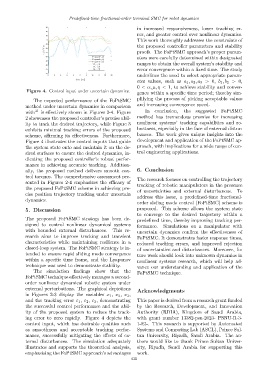
             Figure 4. Control input under uncertain dynamics.
                                                              gence within a specific time period; thereby sim-
                                                              plifying the process of picking acceptable values
                The expected performance of the FoPtSMC
                                                              and increasing convergence speed.
            method under uncertain dynamics in comparison
            with 31  is effectively shown in Figures 2-4. Figure  In  conclusion,  the  suggested  FoPtSMC
            2 showcases the proposed controller’s precise abil-  method has tremendous promise for increasing
            ity to track the desired trajectory, while Figure 3  nonlinear systems’ tracking capabilities and ro-
            exhibits minimal tracking errors of the proposed  bustness, especially in the face of external distur-
            scheme, affirming its effectiveness. Furthermore,  bances. The work gives unique insights into the
            Figure 4 illustrates the control inputs that guide  development and application of the FoPtSMC ap-
            the system state onto and maintain it on the de-  proach, with implications for a wide range of con-
            sired surfaces to ensure the desired dynamics, in-  trol engineering applications.
            dicating the proposed controller’s robust perfor-
            mance in achieving accurate tracking. Addition-
            ally, the proposed method delivers smooth con-    6. Conclusion
            trol torques. The comprehensive assessment pre-   The research focuses on controlling the trajectory
            sented in Figures 2-4 emphasizes the efficacy of
                                                              tracking of robotic manipulators in the presence
            the proposed FoPtSMC scheme in achieving pre-
                                                              of uncertainties and external disturbances. To
            cise position trajectory tracking under uncertain
                                                              address this issue, a predefined-time fractional-
            dynamics.
                                                              order sliding mode control (FoPtSMC) scheme is
            5. Discussion                                     proposed. This scheme allows the system state
                                                              to converge to the desired trajectory within a
            The proposed FoPtSMC strategy has been de-        predefined time, thereby improving tracking per-
            signed to control nonlinear dynamical systems     formance.   Simulations on a manipulator with
            with bounded external disturbances.    This re-   uncertain dynamics confirm the effectiveness of
            search aims to improve tracking and transient     FoPtSMC. It demonstrates faster response times,
            characteristics while maintaining resilience in a  reduced tracking errors, and improved rejection
            closed-loop system. The FoPtSMC strategy is in-   of uncertainties and disturbances. Moreover, fu-
            tended to ensure rapid sliding mode convergence   ture work should look into unknown dynamics in
            within a specific time frame, and the Lyapunov    nonlinear systems research, which will help ad-
            technique was used to demonstrate stability.      vance our understanding and application of the
                The simulation findings show that the         FoPtSMC technique.
            FoPtSMC technique effectively manages a second-
            order nonlinear dynamical robotic system under
            external perturbations. The graphical depictions  Acknowledgments
            in Figures 2-3 display the variables x 1 , x 2 , x 3 ,
            and the tracking error ε 1 , ε 2 , ε 3 , demonstrating  This paper is derived from a research grant funded
            the successful control performance and the abil-  by the Research, Development, and Innovation
            ity of the proposed system to reduce the track-   Authority (RDIA), Kingdom of Saudi Arabia,
            ing error to zero rapidly. Figure 4 depicts the   with grant number 13382-psu-2023- PSNU-R-3-
            control input, which has desirable qualities such  1-EI-. This research is supported by Automated
            as smoothness and acceptable tracking perfor-     Systems and Computing Lab (ASCL), Prince Sul-
            mance, successfully mitigating the effects of ex-  tan University, Riyadh, Saudi Arabia. The au-
            ternal disturbances. The simulation adequately    thors would like to thank Prince Sultan Univer-
            illustrates and supports the theoretical analysis,  sity, Riyadh, Saudi Arabia for supporting this
            emphasizing the FoPtSMC approach’s advantages     work.
                                                           431

