Page 56 - IJOCTA-15-3
P. 56

S. Ahmed et.al. / IJOCTA, Vol.15, No.3, pp.426-434 (2025)
                               n
            torque, and v d ∈ R is bounded external distur-   robotic manipulators.  This control law is de-
            bances.                                           signed to be resilient to disturbances and uncer-
                Equation (3) is provided as follows:          tainties.
              ¨ x = m −1 (x)(v(t) + v d + v u − c(x, ˙x) ˙x − g(x))  3.2. Design of FoPtSMC scheme
                                                        (4)
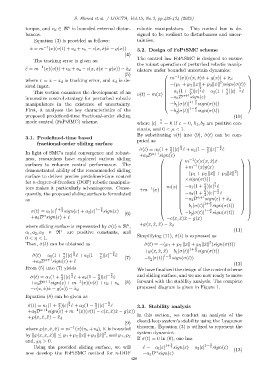
                                                              The control law FoPtSMC is designed to ensure
                The tracking error is given as:
                                                              the robust operation of perturbed robotic manip-
            ¨ ε = m −1 (x)(v(t) + v d + v u − c(x, ˙x) ˙x − g(x)) − ¨x d  ulators under bounded uncertain dynamics:
                                                        (5)                                                   
                                                                             m −1  (x)(c(x, ˙x) ˙x + g(x)) + ¨x d
            where ε = x − x d is tracking error, and x d is de-                                    2
                                                                            −(℘ 1 + ℘ 2 ∥x∥ + ℘ 3 ∥ ˙x∥ )sign(σ(t))  
            sired input.                                                            η    η          η    −  η  
                                                                                                               
                                                                          
                This section examines the development of an                −a 1 (1 + )|ε| 2 ˙ε − a 2 (1 + )|ε|  2 ˙ε 
                                                                                                      2
                                                                                     2
                                                                           −a 3 D
                                                              v(t) = m(x)        α+1 sign(ε)                  
            innovative control strategy for perturbed robotic                           µ                      
                                                                          
            manipulators in the existence of uncertainty.                  −b |σ(t)| 1+ 2 sign(σ(t))          
                                                                               1
                                                                                                               
            First, it analyzes the key characteristics of the                −b |σ(t)| 1−  µ
                                                                                        2 sign(σ(t))
                                                                               2
            proposed predefined-time fractional-order sliding                                            (10)
            mode control (FoPtSMC) scheme.                    where |ε| −  η 2 = 0 if ε = 0, b 1 , b 2 are positive con-
                                                              stants, and 0 < µ < 1.
                                                              By substituting v(t) into (9), ˙σ(t) can be com-
            3.1. Predefined-time based                        puted as
                 fractional-order sliding surface                                η                 η
                                                                                             η
                                                                             η
                                                               ˙ σ(t) = a 1 (1 + )|ε| 2 ˙ε + a 2 (1 − )|ε| − 2 ˙ε
                                                                             2
            In light of SMC’s rapid convergence and robust-    +a 3 D α+1 sign(ε)            2
            ness, researchers have explored various sliding                      m −1 (x)c(x, ˙x) ˙x       
            surfaces to enhance control performance.   The                             −1
                                                                                +m     (x)g(x)             
            demonstrated ability of the recommended sliding                                            2   
                                                                                 −(℘ 1 + ℘ 2 ∥x∥ + ℘ 3 ∥ ˙x∥ )   
            surface to deliver precise predefined-time control                                             
                                                                                 ×sign(σ(t))               
            for n-degree-of-freedom (DOF) robotic manipula-                                   η            
                                                                                            η
                                                                                 −a 1 (1 + )|ε| 2 ˙ε       
            tors makes it particularly advantageous. Conse-    +m  −1    m(x)             2 η  − η         
                                                                                
            quently, the proposed sliding surface is formulated      (x)        −a 2 (1 + )|ε|  2 ˙ε       
                                                                                            2
                                                                                                             
                                                                        
                                                                                −a 3 D α+1                 
                                                                                
            as                                                                             sign(ε) + ¨x d   
                                                                                 −b |σ(t)|   2 sign(σ(t))
                                                                                          1+  µ            
                                                                                     1                      
                            η
                                              η
               σ(t) = a 1 |ε| 1+  2 sign(ε) + a 2 |ε| 1− 2 sign(ε)  (6)           −b |σ(t)| 1−  µ 2 sign(σ(t))  
                                                                        
                                                                                                               
                                                                                      2
                    α
               +a 3 D sign(ε) + ˙ε                                         −c(x, ˙x) ˙x − g(x)
                                                         n
            where sliding surface is represented by σ(t) ∈ R ,  +℘(x, ˙x, ¨x) − ¨x d
            a 1 , a 2 , a 3 ∈ R +  are positive constants, and                                           (11)
                                                              Simplifying (11), ˙σ(t) is expressed as
            0 < η < 1.
                                                                                              2
            Then, ˙σ(t) can be obtained as                        ˙ σ(t) = −(℘ 1 + ℘ 2 ∥x∥ + ℘ 3 ∥ ˙x∥ )sign(σ(t))
                                                                                        µ
                                                                                     1+
                                                                 +℘(x, ˙x, ¨x) − b |σ(t)|  2 sign(σ(t))
                                  η
                                                   η
                                                                               1
                             η
                                             η
                ˙ σ(t) = a 1 (1 + )|ε| 2 ˙ε + a 2 (1 − )|ε| −  2 ˙ε  −b |σ(t)| 1− µ 2 sign(σ(t))
                             2
                                             2
               +a 3 D α+1 sign(ε) + ¨ε                  (7)         2
                                                                                                         (12)
            From (5) into (7) yields                          We have finalized the design of the control scheme
                                 η
                                            η
                            η
               ˙ σ(t) = a 1 (1 + )|ε| 2 ˙ε + a 2 (1 − )|ε| −  η 2 ˙ε  and sliding surface, and we are now ready to move
                            2               2
               +a 3 D α+1 sign(ε) + m −1 (x)(v(t) + v d + v u  (8)  forward with the stability analysis. The complete
                                                              proposed diagram is given in Figure 1.
               −c(x, ˙x) ˙x − g(x)) − ¨x d
            Equation (8) can be given as
                               η
                                           η
                           η
              ˙ σ(t) = a 1 (1 + )|ε| 2 ˙ε + a 2 (1 − )|ε| −  η 2 ˙ε  3.3. Stability analysis
                           2
                                           2
             +a 3 D α+1 sign(ε) + m −1 (x)(v(t) − c(x, ˙x) ˙x − g(x))
                                                              In this section, we conduct an analysis of the
             +℘(x, ˙x, ¨x) − ¨x d
                                                              closed-loop system’s stability using the Lyapunov
                                                        (9)
            where ℘(x, ˙x, ¨x) = m −1 (x)(v u +v d ), it is bounded  theorem. Equation (3) is utilized to represent the
                                               2              system dynamics.
            by ∥℘(x, ˙x, ¨x)∥ ≤ ℘ 1 +℘ 2 ∥x∥+℘ 3 ∥ ˙x∥ , and ℘ 1 , ℘ 2
                                                              If σ(t) = 0 in (6), one has
            and, ℘ 3 > 0.
                                                                             η              1− η
                                                                          1+
                Using the provided sliding surface, we will      ˙ ε = −a 1 |ε|  2 sign(ε) − a 2 |ε|  2 sign(ε)  (13)
                                                                      α
            now develop the FoPtSMC method for n-DOF            −a 3 D sign(ε)
                                                           428
   51   52   53   54   55   56   57   58   59   60   61