


Page 65 - IJOCTA-15-3
P. 65
FPGA design and implementation of fuzzy learning control: Application on DC motor position control

                          y m  (kt)
                               RM             Fuzzy Inverse Model (FIM)
                                                                    BIMF 4    g cm
                                                                                    c r  (kt)
                                           p (kt)                                 z - 1
                                     KBM        g p         BOMF 2    IM
                                                                                   z
                                                     DF 2
                                     Storage
                                                 Learning Mechanism  BIMF 3  g em  e r  (kt)
                            r (kt)  e (kt)
                                       g e   BIMF 1

                                                                                DC Motor
                                    z - 1      IM     BOMF 1     DF 1  g u         Model  y (kt)
                                    z


                                        g c   BIMF 1
                                  c (kt)                 Fuzzy Controller (FC)


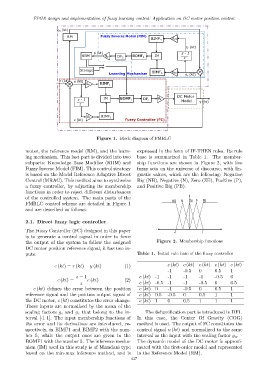
                                            Figure 1. Block diagram of FMRLC

            motor, the reference model (RM), and the learn-   expressed in the form of IF-THEN rules. Its rule
            ing mechanism. This last part is divided into two  base is summarized in Table 1. The member-
            subparts: Knowledge Base Modifier (KBM) and       ship functions are shown in Figure 2, with five
            Fuzzy Inverse Model (FIM). This control strategy  fuzzy sets on the universe of discourse, with lin-
            is based on the Model Reference Adaptive Direct   guistic values, which are the following: Negative
            Control (MRAC). This method aims to synthesize    Big (NB), Negative (N), Zero (ZE), Positive (P),
            a fuzzy controller, by adjusting its membership   and Positive Big (PB).
            functions in order to reject different disturbances
            of the controlled system. The main parts of the
                                                                              NB  N  ZE P  PB
            FMRLC control scheme are detailed in Figure 1
            and are described as follows:

            2.1. Direct fuzzy logic controller
            The Fuzzy Controller (FC) designed in this paper                  -1           1
            is to generate a control signal in order to force
            the output of the system to follow the assigned            Figure 2. Membership functions
            DC motor position reference signal; it has two in-
            puts:                                             Table 1. Initial rule base of the fuzzy controller

                         e (kt) = r (kt) − y (kt)       (1)                 c (kt) c (kt) c (kt) c (kt) c (kt)
                                                                            -1    -0.5   0      0.5    1
                                   z − 1                       e (kt) -1    -1     -1    -1     -0.5   0
                           c (kt) =     e (kt)          (2)
                                     z                         e (kt) -0.5 -1      -1    -0.5   0      0.5
                e (kt) defines the error between the position  e (kt) 0     -1     -0.5  0      0.5    1
            reference signal and the position output signal of  e (kt) 0.5  -0.5  0      0.5    1      1
            the DC motor, c (kt) constitutes the error change.  e (kt) 1    0     0.5    1      1      1
            These inputs are normalized by the mean of the
            scaling factors g e and g c that belong to the in-    The defuzzification part is introduced in DF1.
            terval [-1 1]. The input membership functions of  In this case, the Center Of Gravity (COG)
            the error and its derivatives are introduced, re-  method is used. The output of FC constitutes the
            spectively, in BIMF1 and BIMF2 with the num-      control signal u (kt) and normalized to the same
            ber 5, while the output ones are given in the     interval as the input with the scaling factor g u .
            BOMF1 with the number 5. The inference mecha-     The dynamic model of the DC motor is approxi-
            nism (IM) used in this study is of Mamdani type   mated with the first-order model and represented
            based on the min-max inference method, and is     in the Reference Model (RM).
                                                           437

