


Page 68 - IJOCTA-15-3
P. 68
M. A. Touat / IJOCTA, Vol.15, No.3, pp.435-448 (2025)
            finally implemented on the hardware (FPGA) and    by HDL Coder. The encoder output was pro-
            then tested on the Simulink environment through   grammed as 16 bits, while the PWM input was
            the FIL functionality. 21  In this study, the Xilinx  programmed as 8 bits. The controller output was
            Zedboard is used, which has a Zynq-7000 AP SoC    calculated using the Fixed-Point Tool by combin-
            XC7Z020-CLG484-1 FPGA.     35                     ing 16-bit integers and fractions to ensure accu-
                FIL mode simulation is performed for real-    racy. Figure 6 shows the control diagram devel-
            time DC motor position control. The generated     oped in the Simulink environment.
            VHDL code is executed in the target hardware          This model was implemented via HDL Coder
            to control the DC motor model synthesized in      from Simulink, by ”HDL Workflow Advisor”
            Simulink. The Zedbaord exchanges the send data    through the ”IP Core Generation” functionality.
            of position and signal control in each sampling   This technique makes it possible to generate an
            period with the Simulink environment via the      IP block (Figure 7), whose target hardware is the
            JTAG communication protocol. The concept of       zynq-7000 FPGA. Next, the VHDL code is gen-
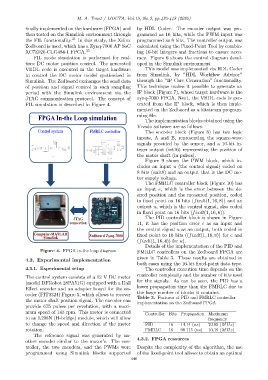
            FIL simulation is described in Figure 4.          erated from the IP block, which is then imple-
                                                              mented on the Zedbaord as a bitstream program-
                                                              ming file.
                  FPGA In-the Loop simulation                     The implementation blocks obtained using the
                                                              Vivado software are as follows:
                  Control system         FMRLC controller         The encoder block (Figure 8) has two logic
                                                              inputs, A and B, representing the square-wave
                                                              signals provided by the sensor, and a 16-bit in-
                                                              teger output (int16) representing the position of
                                                              the motor shaft (in pulses).
                                                                  Figure 9 shows the PWM block, which in-
                                                              cludes an input u (the control signal) coded on
                                                              8 bits (unit8) and an output that is the DC mo-
                                                              tor supply voltage.
                                                                  The FMRLC controller block (Figure 10) has
                                                              an input e, which is the error between the de-
                                                              sired position and the measured position, coded
                                                              in fixed point on 16 bits (fixdt(1, 16, 8)) and an
                                                              output u, which is the control signal, also coded
                                                              in fixed point on 16 bits (fixdt(1, 16, 6)).
                                  JTAG                            The PID controller block is shown in Figure
                                connection                    11, it has the position error e as an input and
                                                              the control signal u as an output, both coded in
                Computer-MATLAB          Zedboard Zynq-7000   fixed point to 16 bits ((fixdt(1, 16, 8)) for e and
                    /Simulink
                                                              (fixdt(1, 16, 4)) for u).
                                                                  Details of the implementation of the PID and
                   Figure 4. FPGA in-the loop diagram         FMRLC controllers on the Zedboard FPGA are
                                                              given in Table 3. These results are obtained in
            4.3. Experimental implementation
                                                              both cases using the 16-bit fixed-point data type.
            4.3.1. Experimental setup                             The controller execution time depends on the
                                                              controller complexity and the number of bits used
            The control system consists of a 12 V DC motor
                                                              for the signals. As can be seen, the PID has a
            (model DFRobot 28PA51G) equipped with a Hall
                                                              lower propagation time than the FMRLC due to
            Effect encoder and an adapter board for the en-
                                                              the large number of blocks it contains.
            coder (FIT0324) Figure 5, which allows to recover
                                                              Table 3. Features of PID and FMRLC controller
            the motor shaft position signal. The encoder can
                                                              implementation on the Zedboard FPGA
            provide 675 pulses per revolution, with a maxi-
            mum speed of 143 rpm. This motor is connected         Controller Bits Propagation Maximum
            to an L298N (H-bridge) module, which will allow                                   frequency
            to change the speed and direction of the motor        PID       16   14.14 (ns)   70.85 (MHz)
            rotation.                                             FMRLC     16   98.115 (ns)  10.19 (MHz)
                The reference signal was generated by an-
                                                              4.3.2. FPGA resources
            other encoder similar to the motor’s. The con-
            troller, the two encoders, and the PWMs were      Despite the complexity of the algorithm, the use
            programmed using Simulink blocks supported        of the fixed-point tool allows to obtain an optimal
                                                           440

