


Page 71 - IJOCTA-15-3
P. 71
FPGA design and implementation of fuzzy learning control: Application on DC motor position control
            VHDL code in terms of computation time and re-    5.1.1. FIL simulation with parametric
            sources consumed by the FPGA circuit.  36,37  Ta-       disturbances
            ble 4 illustrates the hardware resources consumed  In order to prove the efficiency and robustness of
            when implementing the PID and FMRLC con-          the proposed algorithm against parameter uncer-
            trollers on the Zedboard, using a sample rate of
                                                              tainties, these parameters are varied in real-time
            1 MHz. As we can see, the FMRLC control con-
                                                              simulation (see Table 5):
            sumed 12.68% of LUTs (Look Up Table), 0.47% of
            LUTRAMs (Memory LUT), 1.62% of FFs (Flip-         Table 5. DC motor model parameter variations
            Flop), 38.18% of DSPs (Digital Signal Processor),
            6.00% of IOs (Input/Output), 6.38% of BUFGs        Time        t=8s t=15s t=23s t=32s
            (Global Buffer) and 25.00% of MMCMs (Mixed-                                          Dead zone
                                                               Parameter b 0     a 1     a 0
            Mode Clock Manager).                               Value       10    2       2       [-3.1V 3.3V]

            Table 4. FPGA resources consumption

              Resource   Available Utilization  Utilization
                                  (PID)       (FMRLC)
              LUT        53200    651(1.22%) 6801(12.68%)
              LUTRAM 17400        39(0.22%)   81(0.47%)
              FF         106400   664(0.62%) 1725(1.62%)
              DSP        220      6(2.73%)    84(38.18%)
              IO         200      12(6.00%)   12(6.00%)
              BUFG       32       3(9.38%)    3(9.38%)
              MMCM       4        1(25.00%)   1(25.00%)


            5. Results

            5.1. FIL simulation results

            In this section, the results obtained by imple-
            menting the proposed algorithm with FPGA in
            the loop are presented in order to see the be-
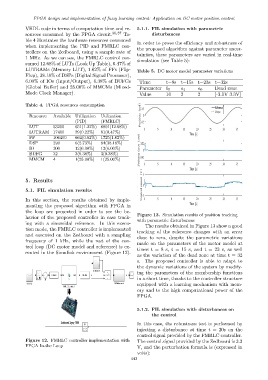
                                                              Figure 13. Simulation results of position tracking
            havior of the proposed controller in case track-
                                                              with parametric disturbances
            ing with a sinusoidal reference. In this execu-       The results obtained in Figure 13 show a good
            tion mode, the FMRLC controller is implemented    tracking of the reference changes with an error
            and executed on the Zedboard with a sampling      close to zero, despite the parametric variations
            frequency of 1 kHz, while the rest of the con-    made on the parameters of the motor model at
            trol loop (DC motor model and reference) is ex-
                                                              times t = 8 s, t = 15 s, and t = 23 s, as well
            ecuted in the Simulink environment (Figure 12).
                                                              as the variation of the dead zone at time t = 32
                                                              s. The proposed controller is able to adapt to
                                                              the dynamic variations of the system by modify-
                                                              ing the parameters of the membership functions
                                                              in a short time, thanks to the controller structure
                                                              equipped with a learning mechanism with mem-
                                                              ory and to the high computational power of the
                                                              FPGA.

                                                              5.1.2. FIL simulation with disturbances on
                                                                    the control
                            Zedboard Zynq-7000                In this case, the robustness test is performed by
                                                              injecting a disturbance at time t = 20s on the
                                                              control signal provided by the FMRLC controller.
            Figure 12. FMRLC controller implementation with   The control signal provided by the Zedboard is 3.3
            FPGA In-the Loop                                  V, and the perturbation formula is (expressed in
                                                              volts):
                                                           443

