


Page 86 - IJOCTA-15-3
P. 86
C. D’Apice et .al. / IJOCTA, Vol.15, No.3, pp.449-463 (2025)


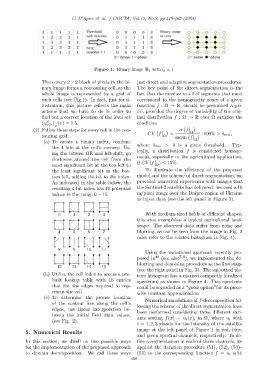
                                           Figure 1. Binary image B j with l j = 1

                    Then every 2 × 2 block of pixels in the bi-  just direct and adaptive segmentation procedures.
                    nary image forms a contouring cell, so the  The key point of the direct segmentation is the
                    whole image is represented by a grid of   fact that the number m+1 of segments that must
                    such cells (see Fig.1). In fact, just for il-  correspond to the homogeneity zones of a given
                    lustration, this picture reflects the main  function f : Ω → R, should be prescribed a pri-
                    actions that we have to do in order to    ori, provided the degree of variability of the orig-
                    find out a correct location of the level set  inal distribution f : Ω → R over Ω satisfies the
                     φ 0 ε,τ   ρ  (x) = 1.5.                 condition
                (2) Follow these steps for every cell in the con-              σ f

                                                                                      Ω
                                                                   CV f    =            · 100% > δ min ,
                    touring grid:                                        Ω     mean f
                    (a) To create a binary index, combine                              Ω
                                                              where δ min > 0 is a given threshold.     Typ-
                        the 4 bits at the cell’s corners: Us-
                                                              ically, a distribution f is considered homoge-
                        ing the bitwise OR and left-shift, go
                                                              neous, especially in the agricultural application,
                        clockwise around the cell from the
                        most significant bit at the top left to  if CV (f   Ω ) ≤ 15%.
                        the least significant bit at the bot-     To illustrate the efficiency of the proposed
                        tom left, adding the bit to the index.  model and the scheme of direct segmentation, we
                        As indicated in the table below, the  provided numerical experiences with images that
                        resulting 4-bit index has 16 potential  the Sentinel-2 satellite has delivered. we used a 10
                        values in the range 0 − 15.           m/pixel image over the Dnipro region of Ukraine
                                                              as input data (see the left panel in Figure 3).


                           0      1     2      3                  With medium-sized fields of different shapes,
                                                              this area exemplifies a typical agricultural land-
                                                              scape. The observed data suffer from noise and
                           4      5     6      7              blurring, as can be seen from the image in Fig. 3
                                                              (also refer to the related histogram in Fig. 4).


                           8      9     10    11
                                                                  Using the variational approach recently pro-
                                                              posed in 40  (see also 7,8 ), we implemented the de-
                                                              blurring and denoizing procedure as the first stage
                          12     13     14    15
                                                              (see the right panel in Fig. 3). The smoothed pic-
                    (b) Utilize the cell index to access a pre-  ture histogram has a marked compactly localized
                        built lookup table with 16 entries    spectrum, as shown in Figure 4. This spectrum
                        that list the edges required to rep-  could be regarded as a “good option”for its piece-
                        resent the cell.                      wise constant approximation.
                    (c) To determine the precise location
                                                                  Numerical simulations of f-decomposition fol-
                        of the contour line along the cell’s
                                                              lowing the scheme of the direct segmentation have
                        edges, use linear interpolation be-
                                                              been performed considering three different vari-
                        tween the initial field data values.
                                                              ants setting f(x) = u i (x), in Ω, where u i with
                        (see Fig. 2).
                                                              i = 1, 2, 3 stands for the intensity of the satellite
                                                              image at the left panel of Figure 1 in red, blue,
            5. Numerical Results
                                                              and green spectral channels, respectively. To de-
            In this section, we dwell on two possible ways    fine a segmentation in each of these channels, we
            for the implementation of the proposed approach   applied the iteration procedure (51), (52), (53)–
            to domain decomposition. We call these ways       (55) to the corresponding function f = u i with
                                                           458

