


Page 81 - IJOCTA-15-3
P. 81
Computational aspects of the crop field segmentation problem based on anisotropic active contour model
∗
R 0
fH ε (φ ε,τ − l m − τ) dx such that φ ∈ BV (Ω) and, up to a subsequence,
τ
c 0 = c m (φ 0 ε,τ ) = R Ω 0 , 0 ∗ m+1
ε,τ,m
Ω H ε (φ ε,τ − l m − τ) dx c ε,τ → c τ in R as ε → 0,
(16) 0 ∗ 1
and the pair φ 0 ε,τ satisfies the following optimality φ ε,τ → φ τ strongly in L (Ω),
∗
∗
f
f
2
condition M Dφ 0 ⇀ M Dφ weakly-∗ in M(Ω; R ),
ε,τ τ
!
Z ∗ ∗
f inf J τ (c, φ) = J τ (c , φ )
0
− f − c ε,τ,0 log 0 (c,φ)∈Ξ τ τ
Ω c ε,τ,0 0 0
= lim J ε,τ (c ε,τ , φ ε,τ ) = lim inf J ε,τ (c, φ),
× δ ε (l 1 − φ 0 − τ)[φ − φ 0 ] dx ε→0 ε→0 (c,φ)∈Ξ ε
ε,τ ε,τ
where the objective functional J τ : Ξ → R is de-
!
m−1 Z
X 0 f
+ f − c ε,τ,j log 0 fined as
j=1 Ω c ε,τ,j Z f
J τ (c, φ) = (f − c 0 ) log χ A dx
τ
0
× δ ε (φ − l j − τ) 0
ε,τ Ω c 0
× H ε (−φ 0 ε,τ + l j+1 + τ)[φ − φ 0 ] dx m−1 Z f h i
ε,τ
X
+ (f − c j ) log τ τ dx
! χ A − χ A j+1
j
m−1 Z c j
X f j=1 Ω
− f − c 0 ε,τ,j log 0 Z
Ω c ε,τ,j f
j=1 + (f − c m ) log χ A m
τ dx
× δ ε (−φ 0 ε,τ + l j+1 + τ) Ω c m
m Z
f
X
× H ε (φ 0 ε,τ − l j − τ)[φ − φ 0 ε,τ ] dx + α |M Dχ E |.
τ
Ω j
Z f j=1
+ f − c 0 log
ε,τ,m 0
Ω c ε,τ,m
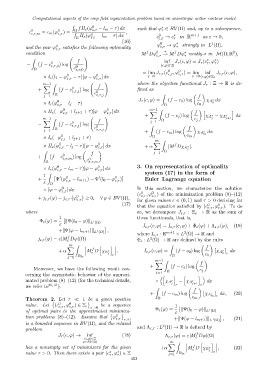
× δ ε (φ 0 − l m − τ)[φ − φ 0 ε,τ ] dx 3. On representation of optimality
ε,τ
Z system (17) in the form of
1 ′ 0 ′ 0
+ Ψ (φ ε,τ − l m+1 ) − Ψ (l 0 − φ ε,τ ) Euler–Lagrange equation
ε Ω
× [φ − φ 0 ] dx In this section, we characterize the solution
ε,τ
(c 0 ε,τ , φ 0 ε,τ ) of the minimization problem (8)–(12)
+ j ε,τ (φ) − j ε,τ φ 0 ≥ 0, ∀ φ ∈ BV (Ω), for given values ε ∈ (0, 1) and τ > 0 deriving for
ε,τ
(17) 0 0
that the equation satisfied by (c ε,τ , φ ε,τ ). To do
where so, we decompose J ε,τ : Ξ ε → R as the sum of
three functionals, that is,
1
Φ ε (φ) = ∥Ψ(l 0 − φ)∥ 1
L (Ω)
ε J ε,τ (c, φ) = I ε,τ (c, φ) + Φ ε (φ) + Λ ε,τ (φ), (19)
+∥Ψ(φ − l m+1 )∥ 1 , m+1 2
L (Ω)
where I ε,τ : R × L (Ω) → R and
f
j ε,τ (φ) = ε|M Dφ|(Ω) Φ ε : L (Ω) → R are defined by the rules
2
ε
Z
m Z
h i
X f f
+ α M D χ E j τ . I ε,τ (c, φ) = (f − c 0 ) log χ A τ 0 ε dx
ε
j=1 Ω 2ε ε Ω c 0
m−1 Z
X f
+ (f − c j ) log
Moreover, we have the following result con- c j
j=1 Ω
cerning the asymptotic behavior of the approxi-
h i h i
mated problem (8)–(12) (for the technical details, × χ A τ − χ A τ dx
we refer to 30,31 ). j ε j+1 ε
f
Z
+ (f − c m ) log χ A m ε dx, (20)
τ
Theorem 2. Let τ ≪ 1 be a given positive Ω c m
0 0
value. Let (c ε,τ , φ ε,τ ) ∈ Ξ ε ε→0 be a sequence 1
of optimal pairs to the approximated minimiza- Φ ε (φ) = ε ∥Ψ(l 0 − φ)∥ 1
L (Ω)
0
tion problems (8)–(12). Assume that φ ε,τ ε>0 +∥Ψ(φ − l m+1 )∥ 1 , (21)
L (Ω)
is a bounded sequence in BV (Ω), and the relaxed 2
problem and Λ ε,τ : L (Ω) → R is defined by
J τ (c, φ) → inf (18) Λ ε,τ (φ) = ε|M Dφ|(Ω)
f
(c,φ)∈Ξ ε
φ∈BV (Ω)
m Z
h i
X
f
has a nonempty set of minimizers for the given +α M D χ E τ , (22)
ε
∗
∗
value τ > 0. Then there exists a pair (c , φ ) ∈ Ξ j=1 Ω 2ε j ε
τ
τ
453

