


Page 93 - IJOCTA-15-3
P. 93
Application of Jumarie-Stancu collocation series method and multi-Step
            effects, provides a flexible and robust mathe-    steps.  By contrast, MSGDTM extends solu-
            matical framework for modeling intricate bio-     tion validity over longer periods while maintain-
            logical systems. 1,2  Its growing significance spans  ing high precision, outperforming conventional
                                                    3
                                                                         61 73
            various disciplines, including engineering, plant  techniques. -  Numerical comparisons indicate
                                                5
                         4
            epidemiology, mathematical biology, medicine, 6   strong agreement between the MSGDTM solu-
            psychology, and life sciences. 7  Additionally, it  tions and those obtained via the classical Runge-
                                              8
            finds applications in viscoelasticity, electromag-  Kutta method when the derivative order is set to
                                    9
            netic wave propagation, quantum mechanics,   10   one.
                    11 22
                                                23 34
            physics, -   and diabetes modeling, -     Com-        It was proposed by Ackerman et al. (1964)
            puter virus,   zoonotic disease. 35  A key fo-    that a 2D linear differential equation could be
            cus   of  this  study  is  to  analyze   system   used to represent glucose tolerance test data.
            stability, bifurcation structures, and chaotic    The mathematical model proposed is as fol-
            dynamics using tools such as phase por-           lows:
            traits, Lyapunov exponents, and bifurcation
            diagrams. 36,37                                           ˆ u(ι) = a 1 ˆv(ι) − a 2 ˆu(ι) + c 1 ,
                                                                      ˙
                                                                      ˙
                                                                      ˆ v(ι) = −a 3 ˆv(ι) − a 4 ˆu(ι) + c 2 + I.
                In order to mitigate chaotic fluctuations, a
                                                                  In these equations, ˆu and ˆv denote insulin
            simple linear controller is introduced.   Stud-
                                                              and glucose concentrations, respectively, and I
            ies show that fractional-order models enhance
                                                              indicates the rate at which blood glucose levels
            glucose-insulin interactions, leading to improved
            diabetes management strategies.  38–40  This re-  increase.  Based on the Lotka-Volterra frame-
                                                              work (Elsadany et al., Elsadany  Shabestari et al. 75
            search integrates fractional calculus, chaos the-
                                                              developed a model to analyze glucose-insulin re-
            ory, and computational simulations to advance
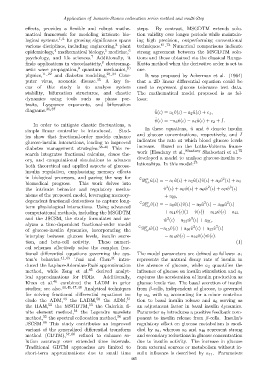
                                                              lationships. In this model: 75
            both theoretical and applied aspects of glucose-
            insulin regulation, emphasizing memory effects
            in biological processes, and paving the way for    C  α                                 2
                                                                D ˆu(ι) = − a 1 ˆu(ι) + a 2 ˆu(ι)ˆv(ι) + a 3 ˆv (ι) + a 4
                                                                  0,ι
            biomedical progress.    This work delves into
                                                                                             2
                                                                           3
                                                                                                       3
            the intricate behavior and regulatory mecha-                  ˆ v (ι) + a 5 ˆw(ι) + a 6 ˆw (ι) + a 7 ˆw (ι)
            nisms of the proposed model, leveraging memory-               + a 20 ,
            dependent fractional derivatives to capture long-
                                                                                                      3
                                                                  α
                                                                                            2
                                                               C D ˆv(ι) = − a 8 ˆu(ι)ˆv(ι) − a 9 ˆu (ι) − a 10 ˆu (ι)
            term physiological interactions. Using advanced       0,ι
            computational methods, including the MSGDTM                   + a 11 ˆv(ι)(1 − ˆv(ι)) − a 12 ˆw(ι) − a 13
            and the JSCSM, the study formulates and an-                   ˆ w (ι) − a 14 ˆw (ι) + a 21 ,
                                                                           2
                                                                                      3
            alyzes a time-dependent fractional-order model
                                                                                       2
                                                                 α
                                                                                                 3
                                                               C D w(ι) =a 15 ˆv(ι) + a 16 ˆv (ι) + a 17 ˆv (ι)
                                                                    ˆ
            of glucose-insulin dynamics, incorporating the       0,ι
            interplay between glucose levels, insulin secre-              − a 18 ˆw(ι) − a 19 ˆv(ι) ˆw(ι).
            tion, and beta-cell activity.    These numeri-                                                (1)
            cal schemes effectively solve the complex frac-
            tional differential equations governing the sys-  The model parameters are defined as follows: a 1
                            41 65
            tem’s behavior. -     Tsai and Chen   44  intro-  represents the natural decay rate of insulin in
            duced the Laplace-Adomian-Pad´e approximation     the absence of glucose, while a 2 quantifies the
            method, while Zeng et al.   45  derived analyt-   influence of glucose on insulin stimulation and a 3
            ical approximations for FDEs.      Additionally,  captures the acceleration of insulin production as
            Khan et al.  46  combined the LADM in prior       glucose levels rise. The basal secretion of insulin
            studies; see also. 44,45,47,48  Analytical techniques  from β-cells, independent of glucose, is governed
            for solving fractional differential equations in-  by a 4 , with a 5 accounting for a minor contribu-
            clude the ADM,   49  the LADM,  50  the ADM, 51   tion to basal insulin release and a 6 serving as
            the HAM,  52  the MSGDTM,   53  the Galerkin fi-  an adjustment factor in basal insulin dynamics.
            nite element method,  54  the Legendre wavelets   Parameter a 7 introduces a positive feedback com-
            method, 55  the spectral collocation method, 56  and  ponent to insulin release from β-cells. Insulin’s
            JSCSM.  66  This study contributes an improved    regulatory effect on glucose metabolism is mod-
            variant of the generalized differential transform  eled by a 8 , whereas a 9 and a 10 represent strong
                              57 60
            method (GDTM), -        refined to enhance so-    and secondary reductions in glucose concentration
            lution accuracy over extended time intervals.     due to insulin activity. The increase in glucose
            Traditional GDTM approaches are limited to        from external sources or metabolism without in-
            short-term approximations due to small time       sulin influence is described by a 11 . Parameters
                                                           465

