


Page 98 - IJOCTA-15-3
P. 98
Sayed Saber et.al. / IJOCTA, Vol.15, No.3, pp.464-482 (2025)
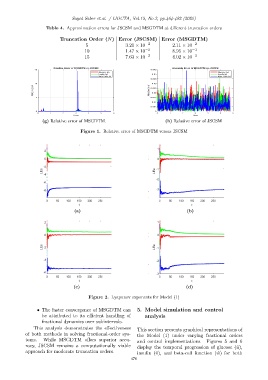
                      Table 4. Approximation errors for JSCSM and MSGDTM at different truncation orders

                            Truncation Order (N) Error (JSCSM) Error (MSGDTM)
                                       5                 3.21 × 10 −2         2.11 × 10 −2
                                       10                1.47 × 10 −2         8.95 × 10 −3
                                       15                7.63 × 10 −3         4.02 × 10 −3


                         Relative Error of MSGDTM vs JSCSM                    Absolute Error of MSGDTM vs JSCSM
                15                                                  0.045
                                             Glucose (x)                                          Glucose (x)
                                             Insulin (y)             0.04                         Insulin (y)
                                             Beta Cells (z)                                       Beta Cells (z)
                                                                    0.035
                10                                                   0.03
                Relative Error                                     Absolute Error  0.025
                                                                     0.02
                 5                                                  0.015
                                                                     0.01
                                                                    0.005
                 0                                                    0
                  0    1     2    3     4     5    6                   0    1     2    3     4     5    6
                                  Time                                                 Time
                    (g) Relative error of MSGDTM.                         (h) Relative error of JSCSM
                                     Figure 1. Relative error of MSGDTM versus JSCSM


                                  (a)                                               (b)


                                  (c)                                               (d)

                                        Figure 2. Lyapunov exponents for Model (1)

                  • The faster convergence of MSGDTM can      5. Model simulation and control
                    be attributed to its efficient handling of   analysis
                    fractional dynamics over subintervals.
                This analysis demonstrates the effectiveness  This section presents graphical representations of
            of both methods in solving fractional-order sys-  the Model (1) under varying fractional orders
            tems.   While MSGDTM offers superior accu-        and control implementations. Figures 5 and 6
            racy, JSCSM remains a computationally viable      display the temporal progression of glucose (ˆu),
            approach for moderate truncation orders.          insulin (ˆv), and beta-cell function ( ˆw) for both
                                                           470

